Manchester's rapid 19th-century expansion from a mill town to an industrial hub left a legacy of variable ground conditions beneath its streets. The city sits on a mix of glacial till, alluvial sands, and soft estuarine clays along the River Irwell and Medlock valleys. This geological patchwork means that bearing capacity can shift dramatically between adjacent plots. A proper bearing capacity analysis in Manchester must account for these contrasts, integrating site-specific soil parameters with Eurocode 7 partial factors. Before designing footings, engineers typically commission a trial pit investigation to retrieve undisturbed samples from the stiff till that underlies much of the city centre, and combine that data with laboratory testing to define the true allowable bearing pressure.
Glacial till in Manchester can show SPT N-values above 40, while soft clays near the Ship Canal fall below 10 — a 400% variation across a few kilometres.
Scope of work in Manchester
Critical ground factors in Manchester
Consider two Manchester neighbourhoods: the sandstone bedrock at 5 m depth in the northern suburbs versus the 15 m of soft clays and peat in Trafford Park. The difference in bearing capacity between these zones is not subtle. In the north, a strip footing may achieve 300 kPa with minimal settlement, while in Trafford Park the same footing could impose stresses that trigger differential settlement of 25 mm or more. A bearing capacity analysis in Manchester that fails to distinguish these geological domains leads to either over-conservative designs — costing thousands in unnecessary concrete — or under-designed foundations that crack finishes and jam doors. The solution is simple: drill enough boreholes and run the correct in-situ tests.
This service complements our laboratory testing work for a complete project analysis.
Our services
Our bearing capacity analysis in Manchester covers three main service lines tailored to local ground conditions.
Shallow Foundation Design Parameters
Determination of net allowable bearing capacity for strip footings, pad foundations, and rafts using SPT correlations, plate load tests, and undrained shear strength from triaxial testing. Output includes settlement estimates under working load.
Deep Foundation Capacity Assessment
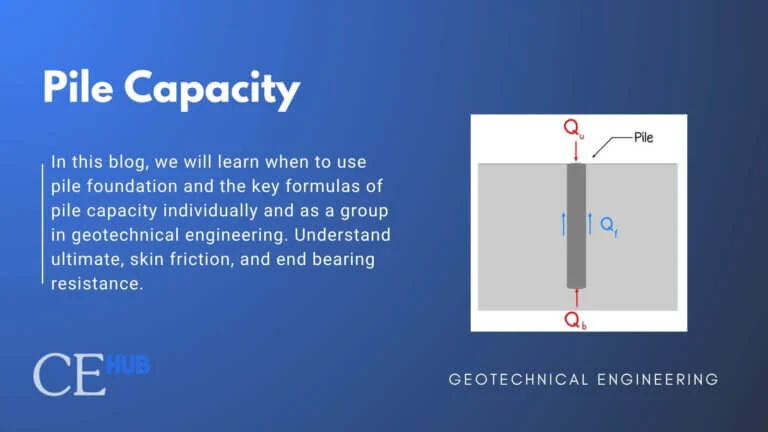
Evaluation of end-bearing and skin friction resistance for driven piles and CFA piles in Manchester's glacial till and sandstone layers. Combines CPT data, SPT N-values, and effective stress analysis per EC7.
Improvement Verification
Post-treatment bearing capacity checks after vibrocompaction, stone columns, or dynamic compaction. Uses in-situ plate load tests and zone load tests to confirm design assumptions for weak alluvial deposits.
Quick answers
What is the typical bearing capacity of glacial till in Manchester?
Glacial till in Manchester typically yields allowable bearing capacities between 200 and 400 kPa, depending on density and moisture content. SPT N-values range from 25 to 50 in the stiff brown till common across central and northern areas.
How much does a bearing capacity analysis cost in Manchester?
A standard bearing capacity analysis in Manchester costs between £470 and £1,280, depending on the number of boreholes, depth of investigation, and laboratory tests required. The range covers SPT correlations through to full triaxial testing suites.
Which Eurocode 7 partial factors apply to bearing capacity in the UK?
For bearing capacity under Eurocode 7, Design Approach 1 is common in the UK. Combination 1 applies partial factors to actions (A1) while Combination 2 applies them to soil parameters (M2) and resistance (R2). The actual factors depend on whether the limit state is persistent, transient, or accidental.
What ground conditions in Manchester require deep foundations instead of shallow footings?
Areas with soft alluvial clays, peat deposits, or made ground exceeding 3 m thickness typically require deep foundations. Sites near the River Irwell or alongside the Bridgewater Canal often show bearing capacities below 80 kPa at shallow depth, making driven piles or CFA piles necessary.