When building on Manchester's glacial till and river terrace deposits, the triaxial test is the standard method for determining shear strength parameters. BS 5930 and Eurocode 7 require reliable effective stress data for any deep excavation or foundation design in the city. The Manchester region has complex ground conditions, with layers of sand, gravel, and stiff clay from the last glaciation. A consolidated drained triaxial test gives you the c' and phi' values needed to model long-term stability. For projects near the River Irwell or the Bridgewater Canal, we often combine this with a corte directo to cross-check results on the same sample set.
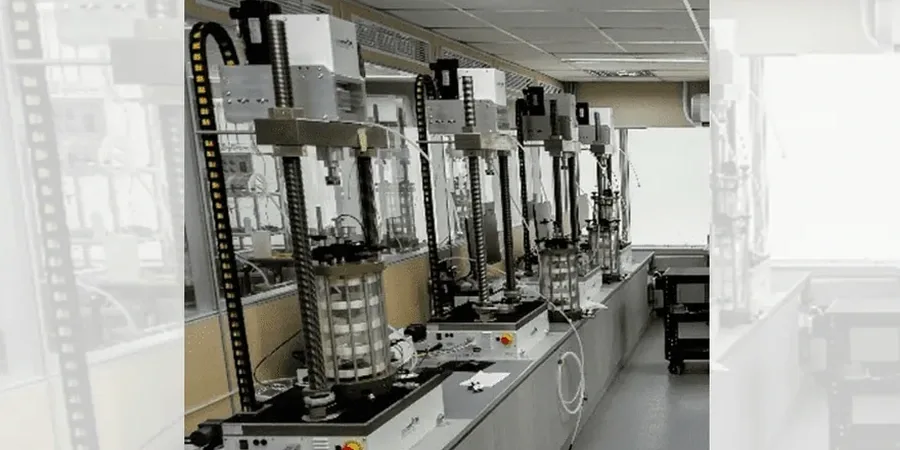
For stiff Manchester clays, a B-value of 0.95 before shearing is non-negotiable. Anything less and your effective stress parameters will be unreliable for design.
Scope of work in Manchester
Critical ground factors in Manchester
A common mistake in Manchester is assuming the glacial till behaves like a uniform clay. It doesn't. The till contains cobbles and sand lenses that create preferential drainage paths. If you run an unconsolidated undrained test on a sample with a hidden sand lens, you get a phi of zero and a su value that is too high. That leads to overestimating short-term stability in temporary excavations. We have seen this cause problems on basement dig-outs in the city centre. The fix is simple: use a consolidated undrained test with pore pressure measurement, and always log the sample photographically before trimming.
This service complements our laboratory testing work for a complete project analysis.
Our services
We offer a full suite of triaxial testing activities tailored to Manchester's ground conditions. Each test is run in our UKAS-accredited laboratory by technicians with knowledge on local projects.
Consolidated Undrained (CU) Triaxial
Standard for effective stress parameters in Manchester clays and tills. Includes back pressure saturation, B-value check, and pore pressure measurement during shearing.
Unconsolidated Undrained (UU) Triaxial
Rapid assessment of undrained shear strength for short-term stability checks. Suitable for temporary works and slope stability in cohesive soils.
Consolidated Drained (CD) Triaxial
Slow drained test for long-term stability analysis. Required for embankment design and retaining wall backfill where full drainage occurs.
Multi-Stage Triaxial
Three consolidation stages on a single sample. Reduces sample variability and saves time. Ideal for projects with limited borehole recovery in Manchester.
Quick answers
What is the difference between UU and CU triaxial tests?
A UU test measures undrained shear strength (su) without allowing drainage during shearing. A CU test consolidates the sample under cell pressure first, then shears undrained while measuring pore pressure. The CU test gives effective stress parameters (c' and phi') needed for long-term design.
How much does a triaxial test cost in Manchester?
The typical cost for a CU triaxial test with three specimens ranges from £1.280 to £2.190, depending on the number of stages and whether you need CD testing. Multi-stage tests on a single sample reduce the total cost.
What sample size do you need for a triaxial test?
We normally use 50 mm diameter samples for standard testing. For gravelly tills found in Manchester, we prefer 70 mm diameter samples to reduce the influence of coarse particles on the failure plane.
How long does a consolidated drained test take?
A CD test can take 5 to 14 days per specimen because shearing must be slow enough to allow full pore pressure dissipation. For faster results, we recommend a CU test with pore pressure measurement, which typically finishes in 2 to 4 days.