Manchester's geology is dominated by glacial till and alluvial deposits along the Irwell and Mersey valleys, with water tables often sitting less than 2 metres below ground. These conditions create differential settlement risks that standard aggregate layers cannot always mitigate. A properly engineered geocell design distributes vertical loads across soft pockets, reducing bearing pressure to manageable levels. We combine this with a placa de carga test on site to verify modulus before placing the geocell layer, and we also check subgrade moisture using in-situ permeabilidad-campo tests, since Manchester's high rainfall — around 800 mm annually — can saturate the formation and compromise confinement.
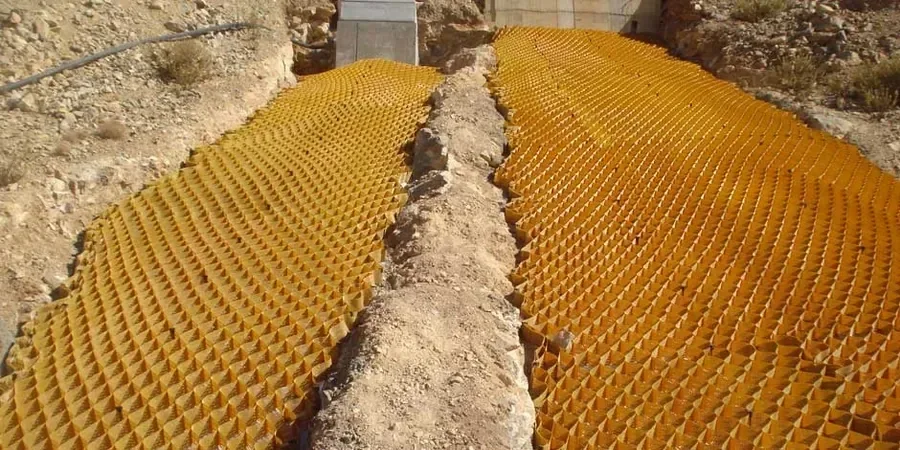
A 200 mm high geocell system with crushed stone infill on peat near Salford Quays supported haul roads under full dump-truck loading.
Scope of work in Manchester
Critical ground factors in Manchester
If the geocell design is underspecified for Manchester's variable ground, the cells can burst at the seams under differential settlement. We have seen a case near the Etihad Campus where a 100 mm cell ruptured on a soft clay lens, causing a 40 mm rut in the access road within six months. The fix required excavation, regrading, and a thicker 200 mm cell with a nonwoven geotextile base. Our team uses finite-element modelling to simulate load distribution across the cell walls and check interface shear at the base. We also verify seam strength per BS 1377 and confirm that the infill material has a friction angle above 40 degrees.
This service complements our laboratory testing work for a complete project analysis.
Our services
We offer two complementary geocell design packages tailored to Manchester's ground conditions.
Geocell design for load support
Design of geocell-reinforced bases for haul roads, parking areas, and temporary works on soft alluvial soils. Includes bearing capacity checks, cell geometry selection, and material specification per BS 8006-1.
Geocell design for slope erosion control
Stabilisation of cut slopes and embankments in Manchester's clay till using vegetated geocell systems. Design includes hydraulic stability analysis and root-reinforcement interaction for long-term performance.
Quick answers
How does the high water table in Manchester affect geocell design?
A high water table reduces the effective stress in the subgrade, lowering its bearing capacity. In Manchester, where groundwater is often within 1.5 metres of the surface, we design geocell systems with a drainage layer underneath and specify open-graded infill to prevent hydrostatic uplift. We also check the factor of safety against buoyancy for buried cells.
What is the typical cost range for a geocell design in Manchester?
A geocell design package for a typical Manchester site — including site visit, bearing capacity assessment, cell specification, and installation drawings — ranges from £720 to £1,990 depending on area size and ground variability. Larger or more complex sites with multiple soil layers may fall at the upper end.
Can geocells be used on peat or very soft clay in the Irwell valley?
Yes, but only with a geotextile separator and careful infill selection. Peat has a natural moisture content above 200% and extremely low shear strength. We design geocell systems for peat using a minimum cell height of 200 mm, crushed angular stone infill with a friction angle above 42 degrees, and a factor of safety of 2.0 on seam strength.
Which British standard applies to geocell design in the UK?
The primary standard is BS 8006-1:2010, which covers reinforced soils and fills. For geocell-specific aspects we also reference Eurocode 7 (EN 1997-1:2004) for bearing capacity and sliding checks. The manufacturer's own design guidelines — validated by independent testing — are used for seam strength and creep behaviour under sustained load.