The contrast between the firm glacial tills underlying Didsbury and the deep alluvial deposits along the River Irwell in Salford illustrates why Manchester demands a site-specific approach to dynamic ground response. A standard borehole alone cannot capture the resonance behaviour that soft soils impose on a structure. An HVSR microtremor survey (Nakamura method) measures the horizontal-to-vertical spectral ratio of ambient vibrations, revealing the fundamental frequency and amplification factor of the soil column. In a city where post-industrial made ground and thick peat layers alternate with competent sandstone, this passive technique provides a rapid, non-invasive way to identify potential resonance conditions before committing to a foundation scheme. The results inform the elastic response spectrum and help engineers decide whether a more detailed amplification sismica study is warranted.
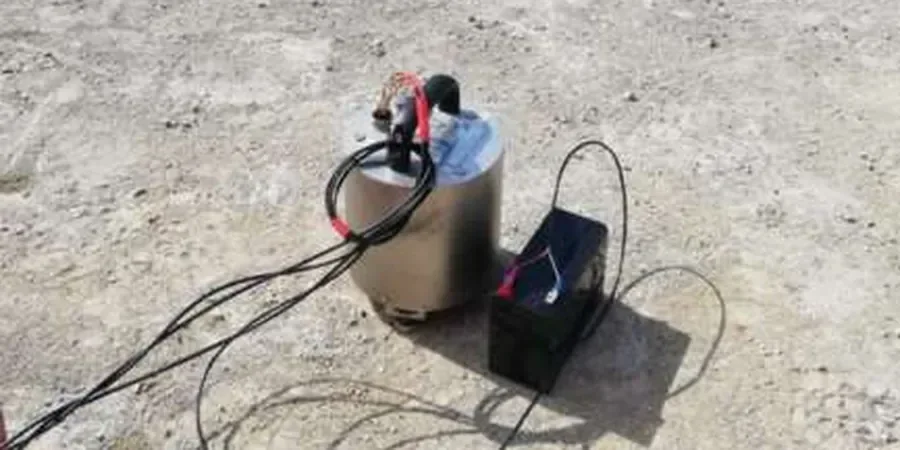
A single-station HVSR recording identifies the fundamental frequency of the soil column in under an hour, avoiding the cost of active-source arrays.
Scope of work in Manchester
- Fundamental frequency f₀ (Hz) of the soil column
- Amplification factor A₀ at the resonant peak
- Site period T (s) for dynamic analysis
- Clarity index (peak definition quality)
- H/V curve shape for layer contrast indication
Critical ground factors in Manchester
The portable seismometer used for the HVSR microtremor survey in Manchester is a compact unit that can be deployed on sidewalk, grass verge, or inside a ground-floor building without traffic disruption. A GPS antenna logs the exact coordinate and time stamp for each recording, while the internal battery allows eight hours of continuous field operation. The main risk in this urban setting is anthropogenic noise from trams, heavy lorries, and construction machinery that can mask the natural microtremor signal. The team mitigates this by scheduling recordings during early morning or late evening hours, and by inspecting the raw time series in real time to reject windows contaminated by transient events. Without this quality-control step, the H/V peak might be misinterpreted as a soil resonance when it actually reflects a passing Metrolink vehicle.
This service complements our laboratory testing work for a complete project analysis.
Our services
We offer two complementary HVSR survey options tailored to the scale and budget of projects across Manchester and the wider North West region.
Single-Station HVSR Survey (Reconnaissance)
Ideal for early-stage site appraisal or small developments on a single plot. Includes one 45-minute recording, on-site processing, and a brief report with the H/V curve and interpreted fundamental frequency. Suitable for verifying the site class prior to foundation design.
Multi-Station HVSR Array (Spatial Mapping)
Designed for larger sites, infrastructure corridors, or seismic microzonation studies. Covers 6 to 12 stations distributed across the area, with contour maps of f₀ and amplification. The final report cross-references results with BS EN 1998-1 site classes and provides recommendations for further dynamic testing if needed.
Quick answers
What is the difference between an HVSR microtremor survey and a MASW array in Manchester?
An HVSR microtremor survey uses ambient vibrations recorded by a single seismometer to find the fundamental resonance frequency and amplification of the site. MASW, by contrast, generates a shear-wave velocity profile through active surface-wave dispersion. HVSR is faster and more portable for urban areas like Manchester, but MASW provides a depth-dependent stiffness profile. The two methods are often complementary: HVSR identifies the resonant period, while MASW supplies the velocity model for numerical site-response analysis.
How much does an HVSR microtremor survey cost in Manchester?
A single-station HVSR survey in the Manchester area typically ranges between £1.230 and £2.250, depending on access logistics, the number of stations, and the level of reporting required. Multi-station arrays or surveys requiring night-time recording for noise minimisation may increase the cost. The price includes equipment deployment, field recording, data processing, and a technical report with the interpreted H/V curves and site-class recommendation under BS EN 1998-1.
When should I request an HVSR microtremor survey instead of a borehole in Manchester?
An HVSR microtremor survey is preferred when the primary concern is dynamic soil behaviour rather than static strength or contamination. For projects near the River Irwell, the Manchester Ship Canal, or areas with thick made ground, the HVSR result directly indicates whether resonance could amplify earthquake or vibration loading. A borehole remains necessary for classification, sampling, and strength testing, but the HVSR survey adds the dynamic layer response that boreholes cannot offer. Combining both gives the most complete picture.