On a recent road widening project near the Manchester Ship Canal, we encountered a persistent issue: groundwater seeping through the granular fill beneath the existing carriageway. The client needed a drainage solution that could handle both surface runoff and subsurface flow without destabilising the embankment. Our team designed a system combining a perforated pipe trench with a geocomposite drainage layer, tied into a new outfall. Before finalising the design, we ran permeability tests in the laboratory on the local glacial till to confirm the drainage coefficient. The system has been performing well through two wet winters, keeping the subgrade dry and the road surface stable.
We test the hydraulic conductivity of local glacial till before designing any drainage system to ensure the filter and pipe sizing are correct.
Scope of work in Manchester
Critical ground factors in Manchester
Manchester's wet climate, with over 800 mm of rain annually, keeps the groundwater table high in many areas. The risk of waterlogging the subgrade and causing pavement failure is real. If a drainage system is undersized or the filter clogs, pore pressures build up under the road surface, reducing shear strength and leading to rutting or cracking. In peat areas, even a small rise in water level can trigger settlement. We always check the seasonal high groundwater level during a wet period and size the drainage system to handle a 1-in-50-year storm event per the local drainage authority guidelines.
This service complements our laboratory testing work for a complete project analysis.
Our services
We offer a full range of geotechnical road drainage activities, from initial site investigation to detailed design and installation supervision.
Drainage design for new roads
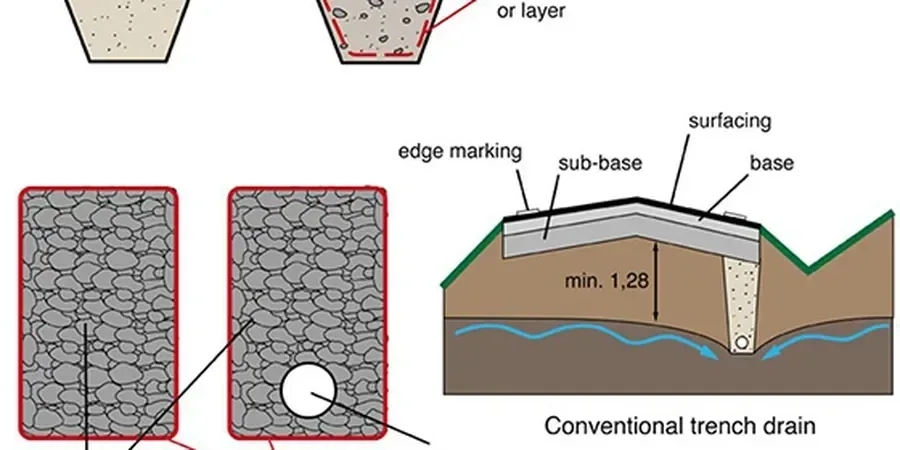
We design bespoke drainage systems for new road construction, including trench drains, fin drains, and geocomposite drainage layers. Our designs account for local soil permeability, rainfall intensity, and traffic loads.
Drainage retrofit for existing roads
For roads suffering from water damage, we assess the existing drainage, identify blockages or undersizing, and design a retrofit solution. We can install new outfalls, replace blocked pipes, or add interception drains.
Permeability testing and soil analysis
We carry out field and laboratory permeability tests on road subgrades and drainage materials. Results are used to specify filter aggregate, geotextile type, and pipe spacing.
Quick answers
How much does a geotechnical road drainage study cost in Manchester?
A typical geotechnical road drainage study in Manchester costs between £760 and £2,220 depending on the site size, number of test pits, and laboratory permeability tests required. This includes a design report with drainage system recommendations.
What is the difference between a fin drain and a trench drain?
A fin drain is a prefabricated geocomposite with a drainage core wrapped in geotextile, installed vertically along the pavement edge. A trench drain is a gravel-filled trench with a perforated pipe at the base. Fin drains are quicker to install and need less excavation, while trench drains handle higher flow rates and are easier to inspect.
How deep should a road drainage trench be in Manchester?
The trench depth depends on the subgrade type and groundwater level. In glacial till with a water table at 1.5 m depth, we typically specify a trench 600 to 900 mm deep with the invert at least 300 mm below the formation level. In peat areas, deeper trenches may be needed to reach a permeable stratum.
Can you design a drainage system for a highway widening project?
Yes, we have knowledge designing drainage for highway widening projects in Manchester. We consider the existing drainage network, traffic management constraints, and the need to maintain flow capacity during construction. Our designs comply with the Design Manual for Roads and Bridges (DMRB).