With over 550,000 residents and a dense urban fabric shaped by the Industrial Revolution, Manchester presents unique challenges for subsurface monitoring. The city's legacy of mill foundations, old mine workings and soft glacial till deposits means that every excavation or basement project demands reliable geotechnical instrumentation. Designing and installing the right sensor network — from inclinometers to piezometers — is not just about compliance; it is about catching ground movement early and avoiding costly delays. Our team has worked on Manchester's tram extensions, high-rise foundations and canal-side developments, tailoring each monitoring plan to the local geology and the specific risk profile of the site.
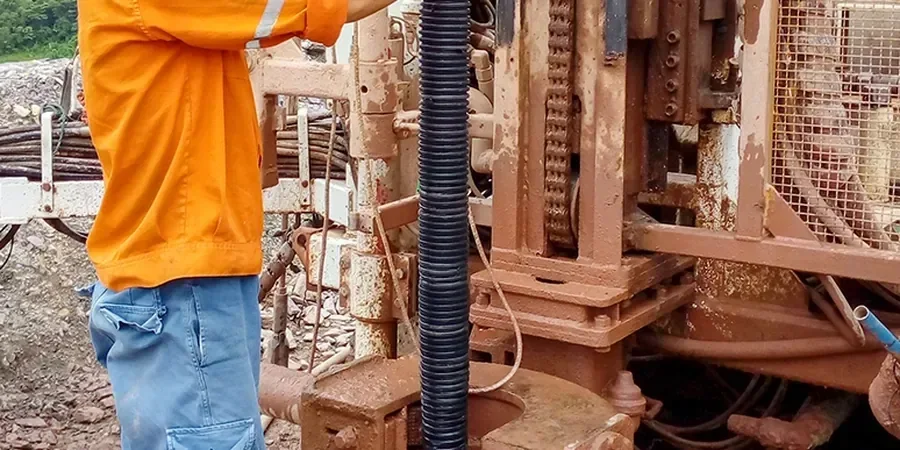
Manchester's legacy of old mine workings and soft glacial till makes integrated instrumentation the only reliable way to protect adjacent structures during excavation.
Scope of work in Manchester
Critical ground factors in Manchester
One issue we see repeatedly in Manchester is the misinterpretation of short-term readings. A sudden spike in pore pressure after a heavy rainstorm might look alarming, but in the laminated glacial till it often dissipates within 48 hours. The real danger is creep movement in old colliery spoil — slow, almost imperceptible displacements that accumulate over months. Without continuous geotechnical instrumentation, a 2 mm shift per week goes unnoticed until a crack appears on the neighbouring building. That is why our design always includes trigger levels with automatic alerts, not just monthly reports. The cost of retrofitting sensors after damage is far higher than installing them before the first shovel hits the ground.
This service complements our laboratory testing work for a complete project analysis.
Our services
We offer a complete geotechnical instrumentation service in Manchester, covering design, supply, installation and data analysis for projects of all scales.
Inclinometer installation and monitoring
Permanent and temporary inclinometer casings installed in boreholes up to 30 m deep, with baseline surveys and scheduled readings using biaxial probes.
Piezometer networks (vibrating wire and standpipe)
Pore pressure monitoring in the glacial till and sandstone aquifers, with automatic datalogging and web-based access for real-time alerts.
Automated total station and prism monitoring
Robotic total stations tracking prisms on retaining walls and adjacent buildings, providing 3D displacement vectors to sub-millimetre accuracy.
Load cells and strain gauges on temporary works
Hydraulic and electrical resistance load cells fitted to struts, anchors and props, integrated with the alarm system for excavation safety.
Quick answers
How long does a typical geotechnical instrumentation installation take in Manchester?
For a medium-sized basement excavation (two to three storeys deep), the drilling and sensor installation takes three to five working days. The monitoring then runs continuously for the duration of the construction phase, often six to eighteen months.
What is the difference between a vibrating-wire piezometer and a standpipe?
A vibrating-wire piezometer provides continuous electronic readings of pore pressure and can be logged automatically, whereas a standpipe requires manual dipping with a water-level meter. We often install both in the same borehole for redundancy, using the standpipe to verify the electronic sensor drift.
Do I need planning permission or approvals for installing geotechnical instruments in Manchester?
Most borehole installations for monitoring purposes do not require full planning permission, but you must notify the Coal Authority if you drill within a defined mining area, which covers large parts of Manchester. We handle the Coal Authority permit application as part of the service.
What trigger levels do you set for alarms on automated monitoring systems?
We follow the CIRIA C760 guidance, setting amber and red thresholds based on the predicted movement of the structure. Typical amber levels are 50 % of the allowable movement, with red at 80 %. Alerts are sent by SMS and email to the site engineer and the designer.