Manchester’s geology is dominated by thick deposits of alluvial sands, silts, and soft clays laid down by the River Irwell and its tributaries. These layers often extend more than 10 m below ground, with groundwater levels sitting between 2 m and 4 m depth. In such conditions, conventional shallow footings can suffer excessive settlement or bearing-capacity failure. Stone column design offers a proven alternative: by installing dense columns of crushed aggregate into the soft matrix, the engineer creates a composite ground with enhanced stiffness and drainage capacity. Before finalising the layout, our team always cross-checks with a permeability test in the field to confirm the drainage characteristics of the native silt and clay horizons. This step ensures the columns will function as vertical drains during construction.
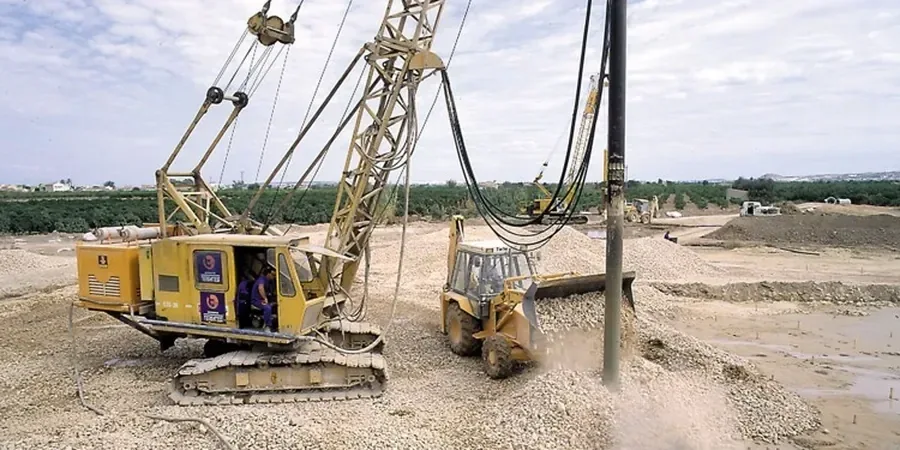
In Manchester’s alluvial clays, stone columns typically achieve settlement reductions of 40 % to 60 % compared to untreated ground.
Scope of work in Manchester
- Bulging failure within the upper 2‑3 diameters of the column, controlled by the lateral confining stress from the surrounding clay.
- Drainage consolidation of the soft matrix as construction loads are applied, which accelerates strength gain in the native soil.
Critical ground factors in Manchester
The north-west of England receives over 900 mm of rainfall annually, and Manchester’s position in a rain-shadow basin means groundwater levels can rise sharply after prolonged wet spells. A common risk during stone column design in this city is underestimating the softening effect of elevated pore pressures on the surrounding clay. If the installation vibrator creates excess pore water that cannot dissipate quickly enough, the lateral confinement around the column drops temporarily, leading to necking or collapse of the fresh aggregate. We mitigate this by sequencing the column installation in a checkerboard pattern, leaving a minimum of 24 hours between adjacent columns to allow pore-pressure dissipation. Where the clay is particularly sensitive, we combine the stone columns with vertical drains to accelerate consolidation before the main structural load is applied.
This service complements our laboratory testing work for a complete project analysis.
Our services
Our stone column design service in Manchester covers the full workflow from desk study to installation specification. We tailor each solution to the client’s load requirements and the site’s particular soil stratigraphy.
Design & Modelling
We produce column layouts using the Priebe method and finite‑element analysis (Plaxis 2D/3D) calibrated against CPT and borehole data from the Manchester area. Deliverables include column diameter, spacing, replacement ratio, and predicted settlement under service loads.
Installation Specification & Supervision
Our engineers prepare method statements, material specifications for the crushed aggregate, and QA/QC procedures. We also offer site supervision during the vibratory installation to ensure the column integrity and verticality meet the design assumptions.
Quick answers
How do stone columns improve soft ground in Manchester?
They act as stiff vertical inclusions that transfer loads to deeper, stronger strata while also providing radial drainage. In the alluvial clays of Manchester, this reduces total and differential settlements by 40 % to 60 % and increases the factor of safety against bearing failure.
What is the typical cost range for stone column design in Manchester?
For a standard commercial or residential project, the design and specification work typically falls between £1,330 and £3,560, depending on the number of load cases, the complexity of the soil profile, and whether supplementary field tests (e.g., CPT or plate load) are required.
Can stone columns be used for liquefaction mitigation?
Yes, in loose granular soils they densify the matrix and offer drainage paths that limit pore‑pressure build‑up. However, Manchester’s soft clays are not generally liquefiable; the main benefit here is settlement control and bearing capacity improvement.
What replacement ratio is recommended for Manchester alluvium?
Based on our local knowledge, a replacement ratio (Ar) between 15 % and 22 % works well for typical building loads. Lower ratios (10 %) suit lightly loaded pavements, while higher ratios (25 %) may be needed for warehouse slabs with point loads above 150 kN.