Working across Manchester, we see a lot of the same ground problems under new road schemes. The legacy of the city's industrial past means shallow made ground, often mixed with soft alluvial clays from the Mersey and Irwell valleys. You get differential settlement when you roll a pavement over that. Soil stabilization for roads in Manchester isn't a standard fix — it depends on the exact mix of fill, moisture content, and plasticity you find. We start with a detailed site investigation to classify the material, then select the right binder. For clay-rich sections we often use lime to modify the moisture first, then cement for strength gain. For deeper soft spots, we might recommend a combination of removal and replacement with engineered fill. Before any treatment begins, we run a granulometria to check the particle size distribution — it tells you if the soil will even react with cement. The whole approach follows BS EN 16907-3 on earthworks and the UK's SHW clause 614 for lime/cement stabilization. You cannot skip the lab work if you want the pavement to last.
Manchester’s soft alluvial clays and variable made ground mean you cannot treat stabilization as a standard recipe — the binder design must be site-specific.
Scope of work in Manchester
Working video
Critical ground factors in Manchester
A common problem we see on Manchester road projects is stabilization failure due to high moisture content in peat or organic clay. The binder simply cannot hydrate properly if the natural water content exceeds about 80%. In those cases, you get a weak, friable layer that cracks under traffic. Another risk is sulfate attack on cement-treated soils where the groundwater contains dissolved gypsum from old colliery spoil. We test for sulfates before specifying the binder. If the levels are high, we switch to a sulfate-resisting cement or use ground granulated blast-furnace slag (GGBS) blended with lime. The worst scenario is when a contractor omits the initial moisture conditioning step — the stabilizer just churns the wet clay into a slurry. We have seen that cause months of delay on a distributor road near Salford Quays.
This service complements our laboratory testing work for a complete project analysis.
Our services
We offer two complementary stabilization approaches tailored to Manchester's ground conditions.
Lime and Cement Stabilization
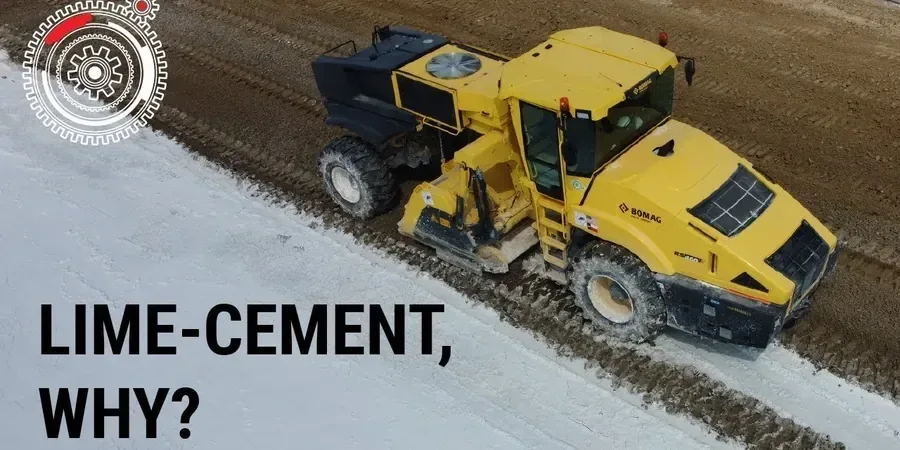
In-situ mixing of quicklime or Portland cement to modify and strengthen the subgrade. We design the binder dosage based on laboratory plasticity tests and target CBR. This method works well on the alluvial clays common across Manchester, reducing plasticity and providing a working platform within days.
Deep Mixing with Binder Columns
For soft spots deeper than 500 mm, we employ deep soil mixing using a rotary tool that injects a cementitious slurry to form columns. This technique stabilizes thick layers of peat or soft clay without full excavation. It is particularly effective for widening existing roads where settlement tolerance is low.
Quick answers
How long does soil stabilization take to cure before paving in Manchester?
Curing time depends on the binder type and weather. With cement stabilization, the treated layer typically reaches sufficient strength after 7 days of moist curing. Lime-stabilized clay needs longer — often 14 to 21 days — because the pozzolanic reaction is slower. We always verify with in-situ CBR testing before the pavement is placed. In Manchester's cool, damp climate, we sometimes extend the cure by covering the layer with a membrane to retain moisture.
What is the difference between lime and cement stabilization for road subgrades?
Lime is primarily a modifier for clay soils. It reduces plasticity, lowers the moisture content through flocculation, and makes the soil easier to compact. Cement adds structural strength by forming a cementitious matrix. If the soil has a plasticity index above 25, we start with lime to modify it, then add cement later if a higher bearing capacity is needed. For granular materials with low plasticity, cement alone is usually sufficient. The choice always depends on the soil classification from the initial testing.
How much does soil stabilization for roads cost in Manchester?
The typical range for in-situ stabilization in the Manchester area is between £630 and £2,520, depending on the depth of treatment, the type of binder, and the volume of material. A small access road with shallow treatment will fall at the lower end, while a deep mixing project on soft ground can reach the upper figure. We always offer a fixed price after the site investigation and lab mix design are completed, so there are no surprises.