Under Eurocode 7 (EN 1997-1:2004) and BS EN 1997-2, our team performs soil liquefaction analysis in Manchester to address the unique ground conditions of the Irwell Valley. The city's deep alluvial deposits—soft silts and loose sands with groundwater tables as shallow as 2 metres—create a scenario where even moderate seismic shaking can trigger pore pressure buildup and loss of shear strength. We follow the NCEER (1997) and Youd-Idriss (2001) SPT-based methodologies to quantify the cyclic resistance ratio (CRR) against the cyclic stress ratio (CSR). This analysis is critical before any deep foundation or slab-on-grade design in Manchester's floodplain areas.
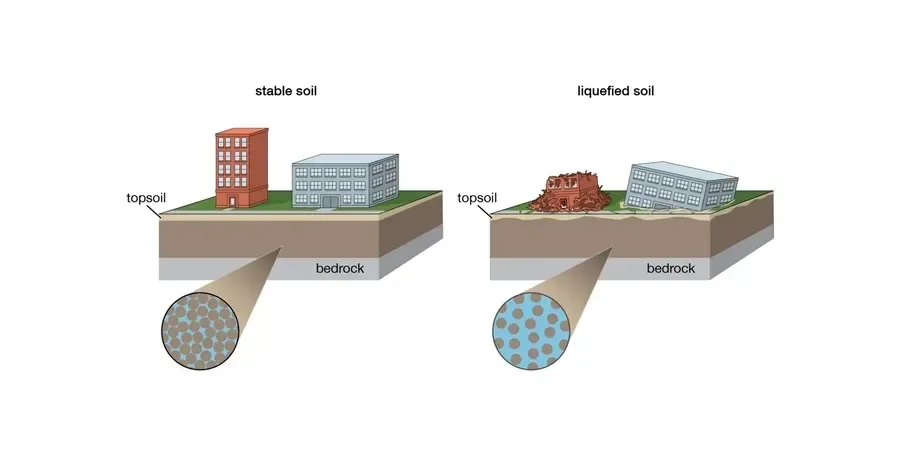
Manchester's shallow water table and loose alluvial sands mean that a magnitude 5.5 earthquake could trigger liquefaction at depths of 3 to 8 metres. Quantifying that risk is not optional.
Scope of work in Manchester
- Field sampling for SPT and CPTU soundings to 25 metres depth
- Laboratory cyclic triaxial tests (BS 1377) on undisturbed samples
- Magnitude scaling factors for a design earthquake of Mw 5.5–6.0 (UK seismic hazard)
- Post-liquefaction settlement and lateral spreading estimates
Critical ground factors in Manchester
The combination of high annual rainfall (over 800 mm) and a perched water table in Manchester's urban fill creates a year-round risk of liquefaction under seismic loading. Unlike drier regions, the ground here rarely drains fully, so pore pressures stay elevated even in summer. Ignoring this can lead to differential settlement of up to 150 mm in a 6-storey building, cracking in pile caps, or tilting of retaining walls. We've seen cases where shallow foundations on the Broughton alluvium required Improvement after a liquefaction analysis flagged a factor of safety below 1.0.
This service complements our laboratory testing work for a complete project analysis.
Our services
We offer three integrated activities for soil liquefaction analysis in Manchester, each tailored to the local geology and project scale.
SPT-Based Liquefaction Assessment
Standard penetration tests at 1.5 m intervals to 25 m depth, corrected for energy ratio and overburden. We compute (N1)60, fines-adjusted CRR, and factor of safety per layer. Includes field logs and laboratory index tests for fines content.
Cyclic Triaxial Testing on Undisturbed Samples
Thin-walled tube samples extracted from key liquefiable horizons and tested under cyclic loading in our UKAS-accredited lab. We determine the cyclic strength curve (number of cycles to failure) at CSR levels matching the design earthquake.
Liquefaction Hazard Zoning & Mitigation Design
Site-specific hazard maps showing liquefaction probability and settlement contours. We recommend Improvement methods such as vibrocompaction or deep soil mixing where FS falls below 1.1, and verify performance with post-treatment SPT or CPT.
Quick answers
What is soil liquefaction and why should I worry about it in Manchester?
Soil liquefaction occurs when loose, saturated sands lose strength during earthquake shaking. In Manchester, the shallow groundwater table and soft alluvial deposits mean that even a moderate earthquake (Mw 5.5) can trigger liquefaction at depths of 3 to 8 metres. This can cause buildings to settle unevenly or float upwards.
How much does a liquefaction analysis cost in Manchester?
A standard liquefaction study for a medium-sized residential plot (4 boreholes to 20 m, SPT and triaxial testing) typically ranges between £2,040 and £3,780. The final cost depends on the number of boreholes, depth of investigation, and whether undisturbed sampling is required.
What method do you use to evaluate liquefaction potential?
We follow the NCEER (1997) SPT-based method by Youd and Idriss. This uses corrected SPT N-values, fines content, and design earthquake magnitude to calculate the cyclic resistance ratio (CRR). We compare this with the cyclic stress ratio (CSR) from the site's seismic hazard analysis. A factor of safety below 1.1 indicates liquefaction risk.
Can you mitigate liquefaction risk after the analysis?
Yes. If the analysis shows a factor of safety below 1.1, we design Improvement solutions such as vibrocompaction, deep soil mixing, or stone columns. These densify the loose sand and improve drainage, reducing pore pressure buildup. We also verify the improvement with post-treatment SPT or CPT testing.