Manchester sits on a thick sequence of Glaciogene till and post-glacial alluvium. The city centre often encounters laminated clay and soft peat layers. These soils undergo significant volume change under load. An oedometer consolidation test measures how fast and how much a soil layer will settle. Without this data, foundation designs miss the real deformation behavior. We run the test on undisturbed samples trimmed directly into the consolidation ring. The setup applies incremental vertical stress while recording axial strain over time. Results give the compression index, recompression index, and coefficient of consolidation. For deep excavations in Spinningfields or Salford Quays, these parameters define the settlement risk. We pair the oedometer test with moisture-density field checks to confirm fill consistency before loading.
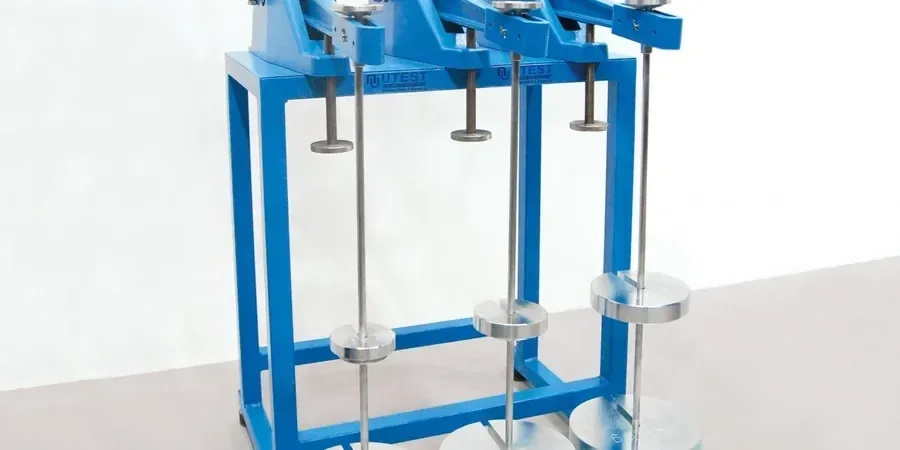
A clay layer only 3 m thick can settle 50 mm under a 150 kPa load. Oedometer data prevents underestimating that movement.
Scope of work in Manchester
- Cc (compression index) – slope of virgin compression line
- Cr (reconsolidation index) – slope of reload branch
- cv (coefficient of consolidation) – from Taylor's square-root-of-time method
- mv (coefficient of volume compressibility) – used in settlement calculations
Critical ground factors in Manchester
The greatest risk with Manchester soils is underestimating secondary compression. Peat layers up to 5 m thick exist under parts of Trafford Park and the Mersey valley. Primary consolidation may finish in weeks, but creep continues for years. A road embankment or a warehouse slab can knowledge differential settlement exceeding 100 mm if creep is ignored. The oedometer test extended to secondary compression stages identifies the creep coefficient Cα. We also recommend a long-term test on a second specimen when peat is suspected. Combining oedometer data with a permeability field test gives a complete picture of drainage paths and rate of settlement.
This service complements our laboratory testing work for a complete project analysis.
Our services
We offer three levels of oedometer service tailored to Manchester project phases.
Standard Incremental Loading (IL)
Eight load increments with 24-hour duration per stage. Reports Cc, Cr, cv, and mv. Suitable for routine commercial developments in the city centre.
Consolidation with Creep Stage
Extended test lasting 7 days on the last load step to measure secondary compression. Essential for peat or organic clay found in Manchester's floodplain areas.
Rapid Loading (CRS – Constant Rate of Strain)
Continuous loading at 0.5–2 % strain per hour. Reduces test time from 10 days to 2 days. Best for preliminary design when schedule is tight.
Quick answers
How long does an oedometer consolidation test take in Manchester?
A standard incremental test with 8 load stages takes 10 working days. The constant-rate-of-strain method finishes in 2 days. Both times include specimen trimming and data processing.
How much does the oedometer consolidation test cost?
The test cost ranges from £160 to £390 per specimen, depending on the number of load increments and whether creep stages are included. Volume discounts apply for multiple specimens from the same site.
What soil types in Manchester require an oedometer test?
Soft laminated clay, peat, and silty alluvium are the main candidates. These materials are common under the Oxford Road corridor, Salford Quays, and the Medlock valley. The test is also required for any structure with a design load above 100 kPa on cohesive ground.