Manchester sits on a mix of glacial till, river terrace deposits, and made ground from its industrial past, with groundwater levels often within 1.5 m of the surface in low-lying areas like the Irwell Valley. For any road project, understanding how these variable soils behave under traffic loads is the foundation of durable pavement design. Our team has been involved in subgrade investigations for residential access roads, industrial estates, and distributor roads across Greater Manchester. We combine In-Situ with laboratory characterisation to offer reliable California Bearing Ratio (CBR) values and compaction parameters, ensuring your pavement design resists the region's wet winters and heavy traffic without premature failure. Before any structural section is placed, we recommend a CBR vial assessment to confirm the subgrade's soaked strength and a densidad cono de arena field check for compaction compliance.
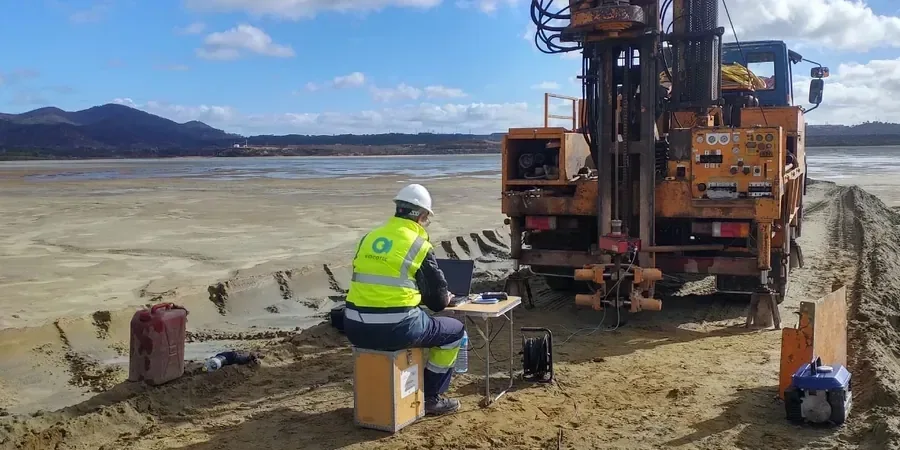
Variable glacial till and made ground in Manchester mean subgrade CBR can range from 1% in wet clay to 15% in compacted granular fill within the same site.
Scope of work in Manchester
Critical ground factors in Manchester
A developer we worked with near the Etihad Campus was designing an access road for a logistics hub. Initial desk study indicated uniform glacial till, but during trial pitting we hit a lens of soft clay within the subgrade. No one had anticipated it because the site had been levelled with imported fill decades ago. If the road had been built on assumed CBR values, the pavement would have cracked within two winters. We adjusted the design by removing the soft material and replacing it with engineered fill compacted to specification. The lesson is simple: in Manchester's urban areas, you cannot trust the surface alone. A proper ground investigation for road geotechnics is the only way to avoid expensive remedial works later.
This service complements our laboratory testing work for a complete project analysis.
Our services
Our road geotechnics activities for Manchester cover every stage from initial ground investigation to final pavement design recommendations.
Subgrade Investigation & CBR Testing
In-situ CBR tests (soaked and unsoaked) plus laboratory determination for design. We correlate results with plasticity, moisture content, and dry density to give you reliable design CBR values for flexible or rigid pavements.
Compaction Control & Earthworks Supervision
We monitor fill placement using sand replacement tests, nuclear density gauge, and Proctor compaction curves. Our technicians attend site during earthworks to verify layer thickness, moisture conditioning, and compaction compliance to SHW Series 600.
Pavement Foundation Design Support
We offer modulus of subgrade reaction (k), elastic modulus (E), and California Bearing Ratio for pavement design software. We also assess frost susceptibility and drainage requirements for Manchester's wet climate.
Quick answers
What CBR value should I use for road pavement design in Manchester?
It depends on the soil type and site conditions. For typical glacial till in Manchester, soaked CBR values range from 2% to 5% at natural moisture content. However, made ground or soft clay can give CBR below 1%. We recommend site-specific testing rather than relying on published correlations.
How much does a road geotechnics investigation in Manchester cost?
A typical investigation for a small residential access road (trial pits, CBR tests, and lab classification) falls between £710 and £1,200. For larger projects involving multiple boreholes, plate load tests, and full laboratory characterisation, the cost ranges from £1,500 to £3,590. Exact pricing depends on site access, number of test locations, and required testing schedule.
What is the difference between soaked and unsoaked CBR?
Unsoaked CBR measures the strength of the subgrade at its natural moisture content. Soaked CBR simulates the worst-case scenario after prolonged rainfall by immersing the sample in water for four days before testing. In Manchester's wet climate, soaked CBR is the more reliable design parameter because subgrades often reach near-saturation during winter months.
Do I need a full ground investigation for a small car park or access road?
Yes, even for small projects. Manchester's variable ground conditions mean that a site with apparently uniform surface may hide soft spots, old foundations, or high groundwater. A basic investigation with two trial pits and three CBR tests costs relatively little compared to the risk of pavement failure and reinstatement.