Manchester’s ground varies sharply between the glacial till of the city centre and the alluvial deposits along the Irwell Valley. In the city centre, stiff boulder clay provides reliable bearing for gravity and cantilever walls. Out in Salford Quays or Trafford Park, soft alluvium and high groundwater demand piled or anchored solutions. Every retaining wall design we deliver in Manchester starts with a site-specific ground investigation. We combine boreholes, SPT profiles, and laboratory triaxial tests to define soil strength parameters precisely. For basement excavations in the Northern Quarter, we often supplement data with permeability field tests to assess dewatering requirements. A wall that works in Didsbury’s dense till may fail in Stretford’s laminated clays. That’s why we tailor each design to the local stratigraphy.
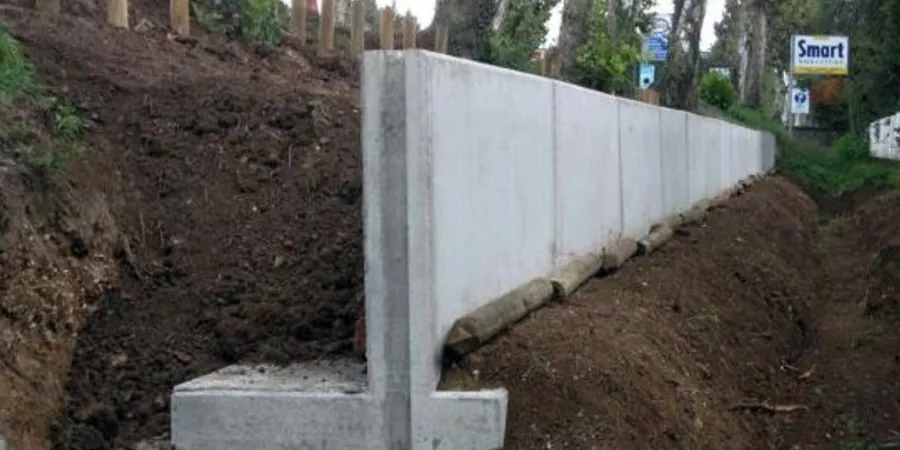
A retaining wall design in Manchester must account for glacial till stiffness, alluvial softness, and water table fluctuations. We calibrate every parameter from local borehole data.
Scope of work in Manchester
Working video
Critical ground factors in Manchester
Manchester sits on a deep sequence of Quaternary deposits. The upper 10 m commonly contain laminated clays with low undrained shear strength – often below 40 kPa. Below that, dense glacial till gives cu values exceeding 150 kPa. The main risk is misinterpreting the transition depth. If a wall is founded in the weak clay instead of the till, sliding or excessive rotation can occur. Groundwater is another hazard. The water table rises after heavy rainfall, increasing active pressure. We always include a drainage layer and weep holes, and we check for potential internal erosion of fine soils behind the wall. Without proper drainage, hydrostatic loads can double the design force. We also verify that adjacent structures are not overloaded by excavation-induced settlement.
This service complements our laboratory testing work for a complete project analysis.
Our services
We offer a complete retaining wall design service, from initial ground investigation through to detailed structural calculations and construction support.
Ground investigation & soil parameter derivation
Boreholes, SPT, undisturbed sampling, triaxial and direct shear tests to obtain c', φ', cu, and stiffness moduli for design.
Structural wall design & limit-state checks
Full Eurocode 7 design for cantilever, gravity, anchored, and secant pile walls. Sliding, overturning, bearing, and global stability are verified.
Drainage & waterproofing specification
Design of granular drainage blankets, geocomposite drains, weep holes, and waterproof membranes to control pore pressures behind the wall.
Construction monitoring & performance verification
Inclinometer installation, settlement markers, and load cells on anchors. We verify that as-built behaviour matches design assumptions.
Quick answers
What is the typical cost range for retaining wall design in Manchester?
For a standard residential basement wall (4–6 m height), design fees range from £820 to £3,580 depending on ground complexity, number of load cases, and whether a full ground investigation is needed. This includes site visit, analysis, drawings, and specification.
Which Eurocode combination is used for retaining wall design in the UK?
We use Design Approach 1 (DA1) as per the UK National Annex to BS EN 1997‑1. Combination 1 applies to structural checks (steel/concrete), Combination 2 applies to geotechnical verification (sliding, bearing). Both are checked in every design.
Do I need a ground investigation before designing a retaining wall in Manchester?
Yes. Without borehole data and lab tests you cannot determine the soil strength or groundwater level. A minimum of two boreholes to 1.5 times the wall height is recommended. We then derive c', φ', and cu for each stratum.
Can a retaining wall be built in soft alluvium near the River Irwell?
Yes, but it requires a piled or anchored solution. Gravity walls are not feasible in soft alluvium due to low bearing capacity and high compressibility. Secant piles or sheet piles driven to the underlying till offer a stable foundation.