The Ménard pressuremeter test probe is a cylindrical cell that expands radially into the borehole wall. In Manchester, we run the PMT using a 63 mm diameter probe lowered into a pre-drilled hole, with readings taken every 0.5 m in depth. The hydraulic control unit applies pressure in 50 kPa increments, recording volume change via a digital sensor. For clays and glacial tills common across the city, the test reaches pressures up to 5 MPa. We complement the borehole preparation with muestreo inalterado to correlate lab results with in-situ stiffness. The entire setup fits in a standard transit van, which is key for tight city-centre sites near the Corn Exchange or Spinningfields.
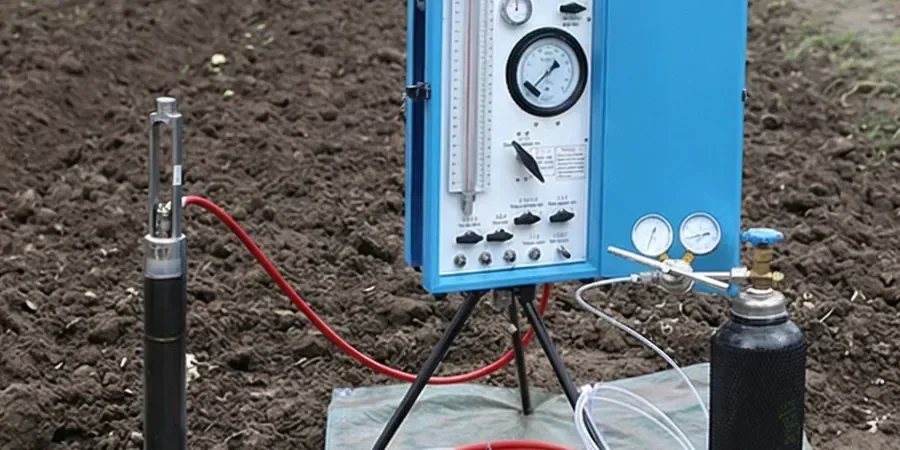
PMT data from glacial till across Manchester shows EM values ranging 15–45 MPa, critical for sizing pad foundations under 3-storey structures.
Scope of work in Manchester
- PMT-1: initial expansion to 15% cavity strain
- PMT-2: hold for 60 s to measure creep
- PMT-3: unload-reload to assess elastic modulus
Critical ground factors in Manchester
Compare two sectors of Manchester: the sandstone outcrops near the city centre yield PL values above 3 MPa, while the soft alluvial clays in Hulme and Salford Quays can drop below 0.8 MPa. That difference means a bearing capacity failure risk in the south-west where PMT data is sparse. We have seen cases where ignoring the low stiffness in the Manchester Ship Canal corridor led to differential settlement exceeding 40 mm. The PMT catches these weak zones before the foundation is cast.
This service complements our laboratory testing work for a complete project analysis.
Our services
We offer three Ménard pressuremeter testing activities tailored to Manchester's ground conditions.
Standard PMT for shallow foundations
Single-cycle Ménard test at 1.0 m intervals down to 10 m depth. Includes EM and PL calculation, creep curve analysis, and a summary report with allowable bearing pressure for pad or strip footings on Manchester till.
Deep PMT for pile design
Multi-cycle PMT with unload-reload loops at pile toe level (typically 12–18 m depth). Provides the Ménard modulus for socket design in sandstone and the limit pressure for shaft friction in cohesive tills.
Pressuremeter profile for settlement analysis
Continuous PMT profile at 0.5 m intervals from ground surface to 20 m. Generates a modulus-depth curve used in finite-element models for raft slabs on Manchester's variable alluvium.
Quick answers
What is the difference between PMT and SPT for Manchester soils?
The SPT gives a blow count N, which is a relative density index. The PMT directly measures the soil's stress-strain response under controlled expansion. For Manchester's glacial till, PMT provides the elastic modulus EM needed for settlement calculations, while SPT is better for liquefaction screening in granular layers.
How deep can the Ménard pressuremeter test reach in Manchester?
With a standard hydraulic control unit and 63 mm probe, we reach depths of 30 m in open boreholes. In the city centre, where boreholes are limited by basement constraints, we commonly test down to 20 m. For deeper requirements near the Airport or Trafford Park, we use a wireline system extending to 40 m.
What is the typical cost range for a PMT campaign in Manchester?
A standard PMT campaign for a medium-rise development in Manchester ranges from £820 to £1,040 per test depth, including mobilisation for sites within the M60 ring road. The final cost depends on the number of test depths, borehole preparation, and access conditions for the rig.
How does PMT data improve foundation design in Manchester's clay soils?
Manchester's glacial till is overconsolidated but contains lenses of softer clay. PMT identifies the limit pressure PL at each depth, allowing the structural engineer to optimise pile lengths and raft thicknesses. Without PMT, designers often over-specify by 15-20% to account for variability, increasing concrete volume and cost.