Manchester's rapid expansion during the Industrial Revolution left a legacy of reclaimed mill ponds, infilled canals, and deep alluvial deposits along the Irwell and Medlock valleys. These man-made and natural ground conditions demand a rigorous approach to foundation design. Pile foundation design in Manchester must account for the city's complex glacial till sequences, which vary dramatically between the city centre's sandstone bedrock and the softer, waterlogged soils of Salford Quays. A thorough site investigation, including boreholes and laboratory testing, is essential. Before finalising the pile layout, we often recommend a complementary resistivity survey (SEV) to map hidden voids or buried structures, or a CPTU for continuous stratigraphic profiling in the deeper alluvium.
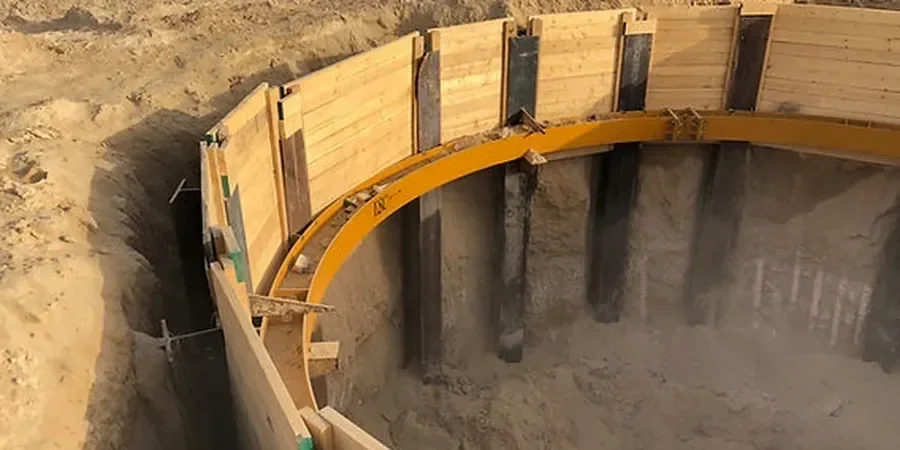
Manchester's glacial till is notoriously variable; a single borehole every 50 metres is rarely enough to confirm pile design parameters.
Scope of work in Manchester
Critical ground factors in Manchester
Greater Manchester's temperate maritime climate brings persistent rainfall averaging over 800 mm per year, keeping the water table high in many districts. This elevated phreatic level complicates pile installation in the fluvial deposits of the Mersey basin — particularly during winter months when pore pressures rise. In areas like Stockport or Wythenshawe, where glacial tills contain perched water tables within sand lenses, hydrostatic uplift can destabilise unlined boreholes during CFA piling. A proper dewatering strategy and use of polymer support fluids become critical. Ignoring these seasonal effects risks concrete contamination or shaft necking, both of which compromise the structural integrity of the foundation.
This service complements our laboratory testing work for a complete project analysis.
Our services
Our pile foundation design activities in Manchester cover the full spectrum, from conceptual design through to construction verification. Each service is tailored to the site's geology and the project's structural demands.
Bored Cast-in-Situ Pile Design
Suitable for Manchester's deeper alluvial soils; diameters from 450 to 1200 mm with full shaft and base grouting where required.
Continuous Flight Auger (CFA) Pile Design
Rapid installation for medium-rise structures in Trafford and Salford; minimises vibration in sensitive urban areas.
Driven Precast Concrete Pile Design
Preferred where dense till or sandstone exists at moderate depth; dynamic load testing to confirm capacity.
Pile Group and Raft Analysis
3D finite element modelling for large podium or tower foundations, including settlement interaction and lateral load distribution.
Quick answers
What is the typical cost range for pile foundation design in Manchester?
For a standard residential or light commercial project, fees typically range between £1,450 and £4,290 depending on the number of boreholes, laboratory tests, and design complexity. Larger or more challenging sites may require additional investigation.
Which soil layers in Manchester most affect pile capacity?
The key layers are the upper made ground (often loose and contaminated), the underlying glacial till (variable clay/silt/sand), and the bedrock sandstone or mudstone. The till's consistency can shift from stiff clay to dense sand within metres, requiring careful sampling.
How deep do piles typically need to be in Manchester city centre?
In the central business district, where sandstone lies 8–15 m below ground, piles often terminate within the rock. In areas like Castlefield or the Quays, where soft alluvium extends deeper, piles may reach 20–25 m to find competent bearing strata.
What is the difference between end-bearing and friction piles for Manchester soils?
End-bearing piles transfer load directly to bedrock or dense till, while friction piles rely on skin friction along the shaft in clay or silt. In Manchester's mixed geology, a combination is common: the shaft resists load in the till and the base bears on sandstone or dense sand.