We worked on a site near the Manchester Ship Canal where a new logistics hub was planned on deep alluvial clays. The ground was so soft that conventional surcharging alone would have taken over two years to achieve the required post-construction settlement. That is when we brought in prefabricated vertical drain design to accelerate the consolidation process. By installing a closely spaced grid of PVDs combined with a temporary surcharge, we cut the waiting time to just eight months. The drains provided a preferential vertical pathway for pore water to escape, allowing the excess pore pressures generated by the fill load to dissipate rapidly. In Manchester's low-lying areas, where the water table sits less than a metre below the surface, this approach is often the only practical way to improve soft ground without resorting to deep foundations or full soil replacement. We always couple PVD design with careful laboratory testing of the clay's consolidation characteristics using oedometer tests, and we cross-check the results against field monitoring of pore pressure dissipation via piezometers installed within the drain field. That combination of design and verification gives contractors confidence that the ground will perform as predicted once the permanent structure is built.
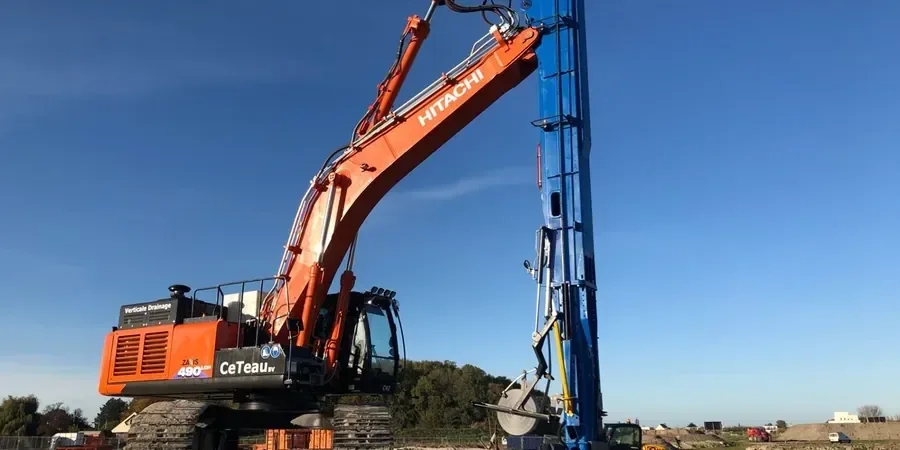
In Manchester's low-lying areas, PVDs cut consolidation time from years to months when combined with careful smear analysis and field piezometer monitoring.
Scope of work in Manchester
Critical ground factors in Manchester
Manchester's climate is relentlessly wet, with annual rainfall exceeding 800 mm and a high water table that rarely drops below 1.5 m depth. This means any PVD installation in the city must contend with groundwater inflow that can soften the working platform and destabilise the mandrel rig. If the site is not properly drained before installation begins, the rig can sink, and the drains may be installed at incorrect depths or with excessive bending. We have seen projects where standing water on the surface caused the drain material to float out of the trench before it could be sealed. To mitigate this, we design a temporary drainage blanket of granular material at least 0.5 m thick beneath the working platform, connected to perimeter ditches that keep the area dewatered. The PVD design itself also has to account for the fact that Manchester's soft clays are often heterogeneous, with interbedded sand lenses that can act as unintended horizontal drains, skewing the consolidation pattern. Without a thorough ground investigation, these lenses can cause differential settlement that cracks the overlying fill or pavement.
This service complements our laboratory testing work for a complete project analysis.
Our services
Beyond PVD design, we offer complementary activities that help you manage soft ground conditions in Manchester from start to finish.
Surcharge and Preloading Design
We calculate the exact height and duration of temporary fill needed to achieve the target settlement before permanent construction begins, integrating PVD spacing to optimise the schedule.
Field Monitoring of Consolidation
Using vibrating-wire piezometers and settlement plates, we track pore pressure dissipation and surface heave in real time during the surcharge period, allowing us to adjust the PVD design if the ground behaves differently than predicted.
Improvement Validation
After the surcharge is removed, we perform cone penetration tests and vane shear tests to confirm that the soil strength has increased to the design value, providing documented evidence for the structural engineer.
Quick answers
How deep can prefabricated vertical drains be installed in Manchester's soft clays?
In practice, drains are typically installed to depths between 8 m and 25 m in the Manchester region. The maximum depth is limited by the mandrel length of the rig, which is usually around 30 m for standard track-mounted equipment. For deeper soft layers, we sometimes use a staged approach where the upper drains are installed first, the ground is improved, and then a second set of drains is driven through the improved layer to reach deeper zones.
What is the typical cost range for a PVD design and installation project in Manchester?
For a medium-sized site of about one hectare with drains spaced at 1.5 m, expect a total project cost between £620 and £2,090 per drain, depending on depth, access conditions, and whether surcharge fill is included. This range covers design, material supply, installation, and basic monitoring. We always recommend requesting a site-specific quote because the ground conditions beneath Manchester vary significantly between the alluvial valleys and the glacial till uplands.
How do I know if my Manchester site needs PVDs or if simple surcharging is enough?
The key factor is the coefficient of consolidation of the clay. If the ch value is below 2 m²/year, undrained surcharging alone will take more than three years to achieve 90% consolidation for a typical 10 m thick layer. In that case, PVDs are almost certainly required. We run a quick one-dimensional consolidation analysis using oedometer data from a single borehole to give you a first estimate. If the predicted time exceeds the project schedule, PVDs become cost-effective.
Can PVDs be installed in winter when the water table is highest?
Yes, but it requires additional site preparation. In Manchester's wet winter months, the water table can rise to within 0.3 m of the surface, turning the working platform into a slurry. We specify a 600 mm thick granular capping layer with geotextile separation and perimeter drainage ditches to keep the rig stable. Installation itself is not affected by cold weather, but the surcharge fill may need to be placed in lifts to avoid bearing capacity failure of the platform.
What happens to the PVDs after the surcharge is removed?
The drains are left in place permanently. They are made of a polypropylene core wrapped in a geotextile filter, so they do not degrade significantly over time. Leaving them in the ground does not affect the long-term performance of the structure because the drains are non-structural and do not create preferential flow paths that could cause internal erosion. In fact, they continue to offer a slight drainage benefit if the water table rises again after construction.