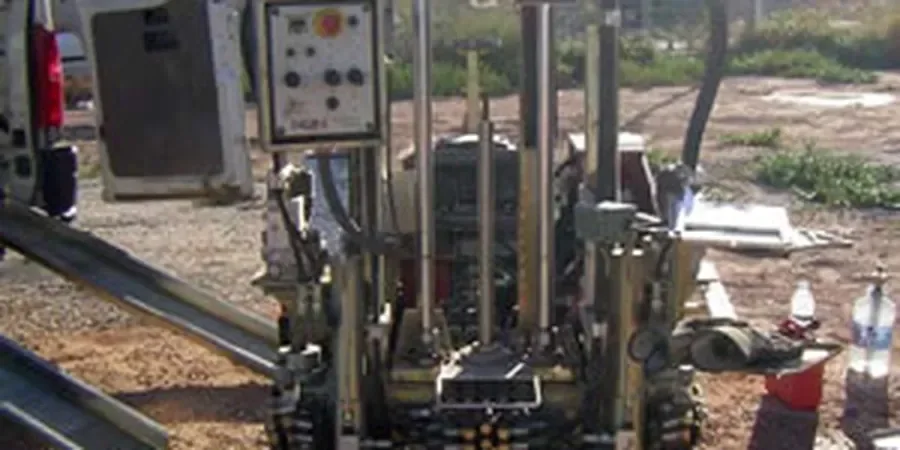
The CPT rig we mobilise in Manchester is a 20-tonne tracked unit equipped with a 10 cm² conical penetrometer. It pushes at a constant rate of 20 mm/s while sensors record cone resistance, sleeve friction and pore pressure continuously. This method is ideal for the layered alluvial deposits, glacial tills and river terrace gravels found beneath the city centre and its suburbs. Because the test produces a near-continuous profile, we can identify thin sand lenses or soft clay pockets that a standard borehole might miss. For projects where undisturbed samples are also needed, we combine CPT with corte directo testing on companion borehole cores. The whole operation is logged digitally on site, and preliminary data is transmitted to the office within hours of finishing the push.
A single 20 m CPT push in Manchester can detect a 0.3 m soft layer that a borehole every 50 m would miss entirely.
Scope of work in Manchester
Critical ground factors in Manchester
Manchester sits on a complex sequence of glacial till, fluvial terrace deposits and weathered Coal Measures sandstone. The till is often dense and contains cobbles, which can damage a standard cone tip or cause refusal above the target depth. In the River Irwell and Medlock valleys, soft alluvial clays up to 8 m thick may have high pore pressure ratios (Bq > 0.8), increasing liquefaction risk under seismic loading. The water table is typically 2-4 m below ground in winter, and artesian conditions occur locally in buried channels. A CPT campaign that stops at refusal in the till may miss deeper sand layers critical for pile design. We mitigate this by pre-drilling through the cobble layer with a rotary rig and then resuming the CPT push from the cleaned borehole base.
This service complements our laboratory testing work for a complete project analysis.
Our services
We offer two complementary CPT-based activities to match the specific ground conditions and project stage in Manchester.
Standard Piezocone Penetration Test (CPTu)
Full 10 cm² cone with u2 pore pressure measurement. Continuous profiling to 30 m depth. Real-time data transmission to client portal. Suitable for soft clays, sands and low-cobble tills. Includes soil classification chart and derived strength parameters.
CPT with Seismic Module (SCPTu)
Adds a downhole shear wave velocity (Vs) measurement every 1 m using a geophone array embedded in the cone. Essential for dynamic analysis, liquefaction assessment (Youd-Idriss method) and site class determination per Eurocode 8. Especially useful for Manchester's deep alluvial basins where resonance periods exceed 0.6 s.
Quick answers
How deep can a CPT reach in Manchester's glacial till?
In clean sand or soft clay we routinely reach 30 m. In dense glacial till with cobbles, refusal may occur at 8-15 m. We pre-drill through the cobble horizon to extend the profile.
What is the cost range for a CPT in Manchester?
A standard 20 m push including mobilisation, data processing and a factual report typically falls between £140 and £180. Volume discounts apply for campaigns of six or more tests.
How does CPT differ from a Standard Penetration Test (SPT) for Manchester soils?
CPT gives a continuous profile versus SPT's discrete 0.3 m samples. In soft clays, CPT provides better resolution of thin layers. In cobble-rich till, SPT may be more reliable because it can drill through obstructions.
Do you provide CPT data for dynamic or seismic design in Manchester?
Yes. Our SCPTu module records shear wave velocity (Vs) at 1 m intervals. Using the Vs profile we compute site class per Eurocode 8 and perform liquefaction triggering analysis following the Youd-Idriss (2001) method.