A common mistake we see on Manchester sites is specifying a geogrid based on a generic catalogue value rather than on the actual soil condition. The Chat Moss peat, the alluvial clays along the Irwell, and the glacial tills that cap the higher ground all demand very different tensile stiffness and aperture geometry. We have pulled out grids that were undersized for a 5 m fill embankment on soft ground near Salford Quays — the contractor had used a uniaxial grid rated for 30 kN/m when the long-term design load required 55 kN/m. Getting the geogrid specification right early avoids that kind of costly rework. Before selecting the grid, we always run a site-specific assessment; often this is combined with a plate load test to confirm the subgrade reaction modulus under the reinforced layer.
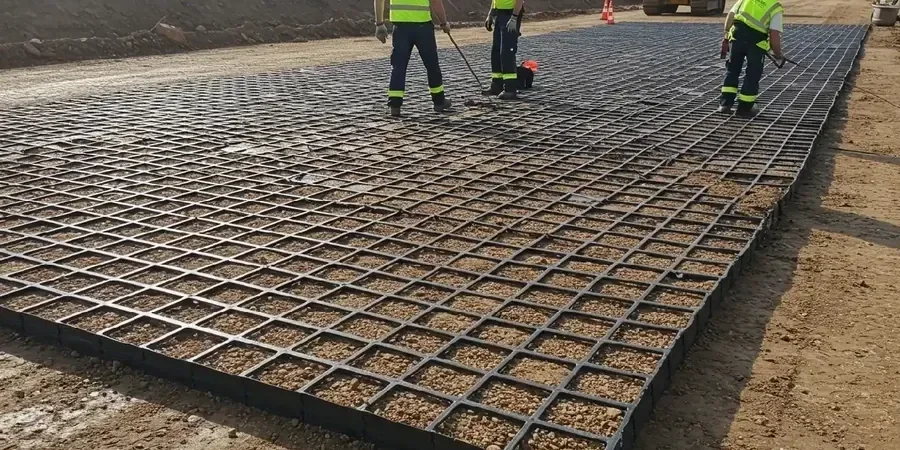
On Manchester soft ground, a generic geogrid catalogue value can lead to a 0.6 m overspend in fill — site-specific specification pays for itself.
Scope of work in Manchester
Critical ground factors in Manchester
Eurocode 7 (BS EN 1997-1:2004) requires that the design of reinforced soil structures uses characteristic values derived from site-specific testing, not default values from a manufacturer's table. In Manchester, where the water table can be within 1 m of the surface in the river valleys, the risk of reduced interface friction due to pore pressure is real. We have seen base sliding failures on reinforced slopes where the grid was specified without accounting for the softened subgrade. Our team runs direct shear tests on the soil-grid interface under saturated conditions to give you a realistic design parameter. This is particularly relevant when the reinforcement is used in slope stability works on the steep valley sides of the Mersey or the Medlock.
This service complements our laboratory testing work for a complete project analysis.
Our services
We offer three specialised activities to support geogrid specification in Manchester, from laboratory testing to design verification.
Soil-grid interaction testing
Direct shear and pullout tests on the candidate geogrid embedded in the actual site soil. We report interface friction angle, adhesion, and pullout resistance at the design normal stress.
Long-term design strength assessment
Creep tests and installation damage trials to calculate the reduction factors required by BS 8006-1. We deliver a certified design strength for your specific grid and subgrade.
Geogrid specification review & optimisation
We audit existing specifications against the site's CBR, particle size distribution, and groundwater conditions. When the grid is over-specified, we propose a more cost-effective alternative.
Quick answers
What is the difference between a uniaxial and a biaxial geogrid for Manchester ground?
A uniaxial grid has high strength in one direction — it is used for retaining walls and steep slopes where the principal tensile load is horizontal. A biaxial grid has similar strength in both directions and is typical for base reinforcement on soft ground, like the alluvial clays found in Manchester's river valleys. The choice depends on the stress field and the failure mechanism.
How much does a geogrid specification service cost in Manchester?
A full specification package — including soil-grid interaction testing, long-term strength assessment, and a written design report — typically ranges from £410 to £890 depending on the number of grid types tested and the complexity of the subgrade. A basic review of an existing specification starts around £330.
Why can't I use the manufacturer's published tensile strength directly in my design?
The manufacturer's value is a short-term ultimate strength tested in air at 20 degrees Celsius. In the ground, the geogrid suffers creep under sustained load, potential damage during installation, and chemical/biological degradation. Eurocode 7 and BS 8006-1 require reduction factors for each of these effects. Without site-specific testing, you might overestimate the available strength by 40% or more.