Eurocode 7 (EN 1997-1:2004) and BS 5930 set the framework for pile design in the UK, but in Manchester the split between skin friction and end bearing demands site-specific data. The city's geology—glacial tills overlying Coal Measures sandstone and mudstone—creates a layered profile where shaft resistance in the dense till can dominate, while the tip bears on stronger bedrock. We routinely run static load tests and instrumented piles to isolate these components. Before committing to a pile type, a detailed study of soil classification helps us correlate index properties with shear strength along the shaft. This approach avoids over-design and keeps foundation costs in check across Manchester's variable ground conditions.
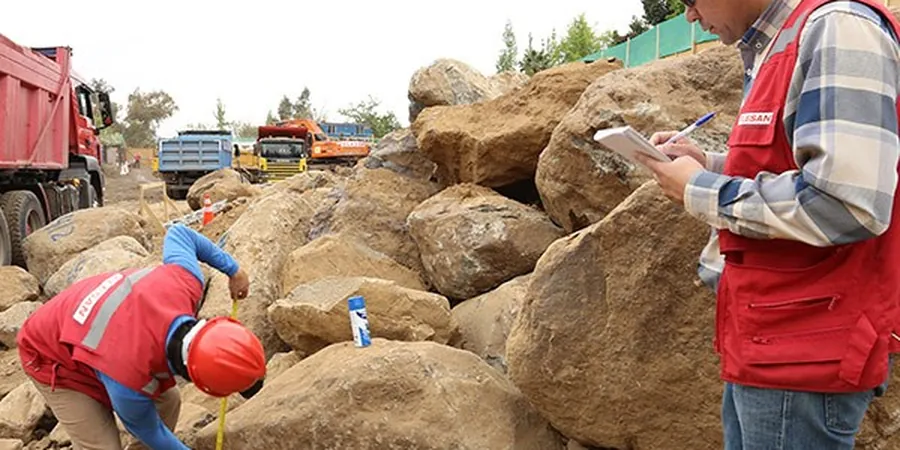
In Manchester's tills, skin friction accounts for 70-80% of pile capacity; in Coal Measures rock, end bearing dominates. Site-specific analysis changes the design.
Scope of work in Manchester
Working video
Critical ground factors in Manchester
Manchester's glacial geology includes laminated clays and sand lenses within the till, which can cause sudden drops in skin friction at certain horizons. If the pile socket passes through a sand seam, shaft resistance may reduce locally by 30-40%, shifting load to the tip before it is designed to carry it. The Coal Measures bedrock is also laterally variable; mudstone bands within the sandstone sequence offer much lower end bearing values. Without a detailed load-transfer analysis, a pile designed as end-bearing may actually shed significant load through the shaft, or vice versa. This mismatch can lead to excessive settlement or even structural distress in the superstructure.
This service complements our laboratory testing work for a complete project analysis.
Our services
We offer two complementary activities to quantify the skin friction and end bearing components for piles in Manchester:
Instrumented Static Load Test
We install vibrating-wire strain gauges at multiple levels along the pile shaft and a load cell at the base. During a maintained load test, we record strain increments at each load stage. The data are processed to separate shaft resistance from end bearing, producing t-z and q-z curves specific to your site. This service is essential for validating design assumptions on projects where pile capacity is critical.
Load-Transfer Analysis & Design Review
Using soil parameters from our laboratory testing (direct shear, triaxial, index properties) and in-situ profiles from CPT or SPT, we run a load-transfer analysis (t-z/q-z method) to predict the pile response under working and ultimate loads. We calibrate the model against local pile test records from Manchester. The deliverable includes a report with recommended pile lengths, diameters, and allowable loads.
Quick answers
How does the glacial till in Manchester affect the skin friction vs. end bearing split?
Manchester's glacial till is a dense, overconsolidated clay with occasional sand lenses. In this material, skin friction typically provides 70-80% of the pile's ultimate capacity. The shaft resistance depends on the undrained shear strength of the till, which can range from 150 to 250 kPa. End bearing only becomes significant once the pile tips into the underlying Coal Measures sandstone or mudstone. We use instrumented load tests to quantify the split at each specific site.
What is the typical cost range for an instrumented pile load test in Manchester?
The cost for an instrumented static load test in Manchester typically falls between £930 and £2,760, depending on pile diameter, test load magnitude, and the number of strain gauge levels installed. This includes mobilisation, installation of gauges, data acquisition, and a full report with t-z and q-z curves. More complex tests with multiple reaction piles or Osterberg cells will be at the higher end of this range.
When should I choose end-bearing piles over friction piles in Manchester?
End-bearing piles are the right choice when the bedrock (Coal Measures sandstone) is within reachable depth—typically less than 25 m in parts of the city centre. Friction piles, relying on shaft resistance in the glacial till, are more economical where bedrock is deeper, such as in Didsbury or Chorlton. However, the till's sand lenses can reduce shaft resistance locally, so a proper load-transfer analysis is essential before deciding. We often recommend a combination: a friction pile in the till with a socket into the bedrock for end bearing.