Eurocode 7 (BS EN 1997) and BS 5930 govern grouting design across the UK, but Manchester's subsurface demands extra attention. The city sits on a mix of glacial till, laminated clays, and the heavily fissured Collyhurst Sandstone that underlies the urban core. These permeable sandstone beds can transmit water rapidly along joints, making uncontrolled groundwater ingress a real risk during basement excavation or tunnel works. A properly sequenced injection program seals discontinuities and controls seepage. Before writing a grout specification, the team typically runs packer permeability tests and cross-checks results with permeability field testing to confirm the target zone's response. The design then selects a suspension or solution grout that matches the fracture aperture and groundwater chemistry found on site.
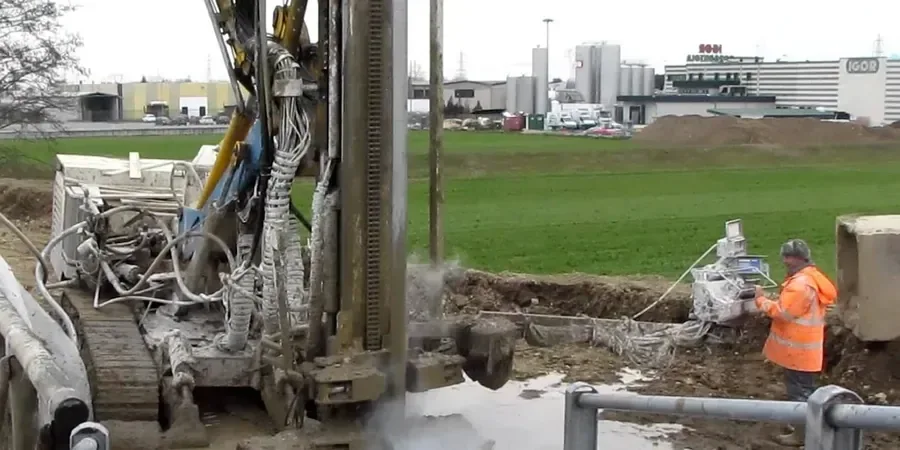
Manchester's fractured sandstone can transmit groundwater at rates 10 times higher than the surrounding till, demanding separate grout formulations for each stratum.
Scope of work in Manchester
Critical ground factors in Manchester
Manchester's historical industrial legacy means the shallow ground contains old foundations, buried mill races, and abandoned coal workings. These voids and obstructions can divert grout away from intended zones, leaving untreated pathways for water. The sandstone itself is highly anisotropic — fracture spacing varies from centimetres to metres within a single borehole. If the injection program ignores these discontinuities, the result is either wasteful grout loss into open voids or incomplete sealing. A staged approach with real-time pressure monitoring and periodic coring checks helps the team adjust the grout mix on the fly. Without this feedback loop, the risk of post-construction leakage into a finished basement or tunnel rises significantly in a city built on such variable ground.
This service complements our laboratory testing work for a complete project analysis.
Our services
Our grouting design team offers three core activities tailored to Manchester's ground conditions.
Permeation Grouting Design
Targeted injection of low-viscosity suspensions into sandstone fractures to reduce permeability and control groundwater ingress. Includes packer testing, fracture mapping, and real-time pressure monitoring.
Compaction Grouting in Glacial Till
High-mobility grout injected under controlled pressure to densify loose till zones and fill voids left by historical excavations. Suitable for shallow foundations and slab support.
Jet Grouting for Cut-Off Walls
Erosion-mixing technique that creates continuous columns of soil-cement in cohesive and granular soils. Designed for basement perimeter cut-offs and tunnel portal seals.
Quick answers
How does Manchester's sandstone affect grout selection?
The Collyhurst Sandstone contains open fractures that require a stable, low-viscosity suspension or solution grout. A w/c ratio around 0.8:1 with a superplasticiser helps the grout penetrate fissures down to 0.1 mm. Cement-bentonite blends are common for wider joints.
What is the typical cost range for grouting design in Manchester?
A full grouting design package — including site investigation review, laboratory formulation, injection specification, and post-treatment verification — generally falls between £1,050 and £3,440. The final figure depends on the number of injection stages and the complexity of the ground profile.
Can grouting be combined with other Improvement methods?
Yes. In Manchester, grouting is often sequenced with deep soil mixing or vibro stone columns where the till and sandstone present contrasting behaviours. The design team coordinates the injection program so that grout does not interfere with subsequent improvement works.
How is the success of a grouting program verified?
Verification relies on coring through treated zones, extracting intact samples for unconfined compressive strength testing, and performing post-grout packer permeability tests. Water inflow measurements in adjacent excavations offer a practical field check.