Our mixing plant arrives on site with a pugmill capable of processing up to 300 tonnes per hour, feeding directly into a spreader box that lays treated material at precise depth and width. In Manchester, where the underlying geology shifts from glacial till in the north to alluvial deposits along the Irwell Valley, this equipment is essential for achieving uniform blending of lime or cement with the native soil. The process begins with pulverisation to break down clods, followed by dry binder injection and water addition to reach optimum moisture; a final mixing pass ensures homogeneity before compaction begins. This mechanical approach, backed by laboratory formulation tests, guarantees that each batch meets the target strength parameters for the specific project.
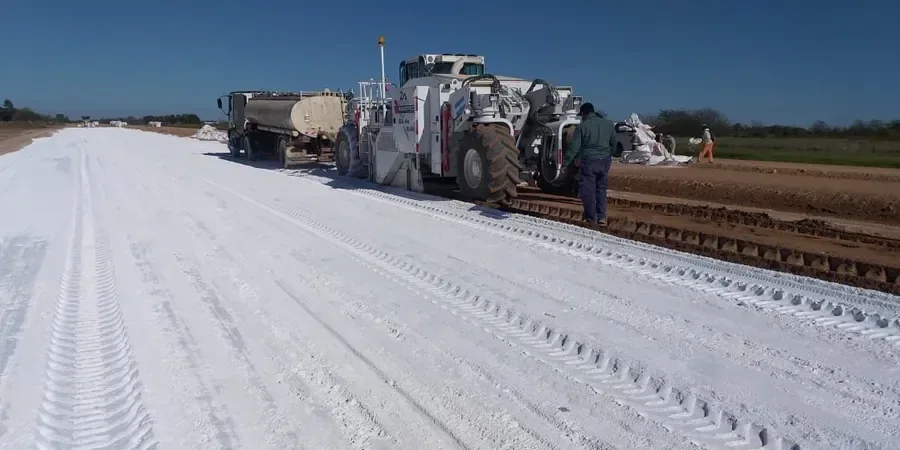
Lime stabilisation can reduce plasticity index from 35% to below 15% in Manchester's glacial till, transforming a difficult clay into a workable subgrade.
Scope of work in Manchester
Critical ground factors in Manchester
Eurocode 7 (EN 1997-1:2004) requires that Improvement be verified through both design calculations and field testing. In Manchester, the risk of differential settlement is high where treatment thickness varies across a site, especially on the sloping ground between the city centre and the Medlock Valley. Without proper quality control — daily in-situ density checks and strength testing of cured cores — a stabilised layer can fail to reach its design CBR, leading to cracking in pavements or uneven bearing under shallow foundations. We follow the Specification for Highway Works Series 800, using a field technician on every shift to monitor mixing uniformity and moisture content, so the risk is managed before compaction.
This service complements our laboratory testing work for a complete project analysis.
Our services
We deliver three core service lines for lime and cement stabilization in Manchester, each tailored to the project stage and soil conditions.
Laboratory Mix Design
Determination of optimum binder type and dosage through Atterberg limits, compaction, and unconfined compressive strength tests. We simulate field moisture and compaction conditions to offer a certified mix design specific to your Manchester site.
In-Situ Stabilization Works
Full contracting service including pulverisation, binder spreading, mixing, moisture conditioning, and compaction. We offer daily quality control reports with in-situ density, moisture content, and strength data.
Verification Testing & Certification
Post-treatment coring, UCS testing at 7 and 28 days, and CBR testing on site. We issue a signed compliance certificate against the project specification and relevant British Standards.
Quick answers
What is the difference between lime and cement stabilization?
Lime stabilization is best for plastic clays: it reduces plasticity, swell potential, and makes the soil more workable through a pozzolanic reaction that takes 14–28 days to develop significant strength. Cement stabilization works better on granular soils or low-plasticity silts, delivering strength gain within 7 days through hydration. The choice depends on the soil classification and the required strength gain rate.
How much does lime and cement stabilization cost in Manchester?
For a typical project in Manchester, the cost ranges between £730 and £1,810 depending on the binder dosage, layer thickness, and site access. This includes laboratory mix design, mobilization of the pugmill and spreader, full treatment works, and verification testing. Larger volumes reduce the per-tonne rate, while sites with restricted access or contaminated ground may increase costs.
What depth of treatment can be achieved?
Single-lift treatment is limited to 250 mm compacted thickness to ensure uniform mixing and compaction. For deeper improvement, we work in multiple lifts of 200–250 mm each, compacting and curing each layer before placing the next. Total treatment depth of 500–750 mm is common for road subgrades and foundation platforms.
How do you verify the quality of the stabilized layer?
We perform daily in-situ density tests using a nuclear gauge or sand replacement method, check mixing uniformity by visual and laboratory analysis, and take core samples for UCS testing at 7 and 28 days. All results are recorded in a quality control log and submitted with the compliance certificate.