A road widening project near the Manchester Ship Canal revealed a common challenge: the existing clay subgrade had soaked up decades of industrial runoff, turning the top 300 mm into a soft slurry. For any new pavement to last, we needed a reliable measure of its soaked bearing capacity. That is where a focused CBR study for road design becomes essential. In Manchester, where the geological profile mixes glacial till with river terrace deposits, the soaked CBR at field density often falls below 2.5 % in winter. Without this data, pavement thickness design defaults to conservative estimates that inflate costs unnecessarily. We set up test pits along the alignment, extracted undisturbed block samples, and ran soaked CBR tests in the lab to match the worst-case moisture scenario. The results allowed the design team to tailor the subbase depth exactly, avoiding both over-engineering and premature failure.
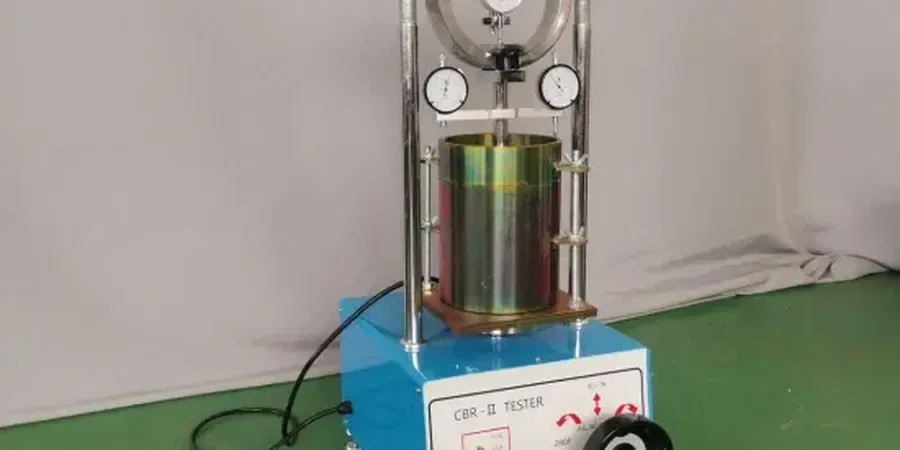
Soaked CBR values in Manchester's glacial till often drop below 2.5 % in winter, making laboratory simulation essential for pavement design.
Scope of work in Manchester
Critical ground factors in Manchester
Eurocode 7 (EN 1997-1:2004) and BS 5930 both require that the design subgrade strength be based on the worst credible moisture condition. In Manchester, that means the soaked CBR. The risk is real: a developer near the Irwell Valley recently specified pavement based on unsoaked CBR values from a dry summer test. After the first wet winter, the subgrade softened, the subbase cracked, and the entire car park had to be replaced within 18 months. A proper CBR study for road design would have caught the 60 % strength loss. The lesson is simple: never design a pavement in Manchester without soaked CBR data from the actual season of placement.
This service complements our laboratory testing work for a complete project analysis.
Our services
We offer three complementary CBR study activities tailored to road design projects in Manchester.
Laboratory Soaked CBR Tests
BS 1377-4 compliant tests on remoulded and undisturbed samples. We simulate 4-day soaking to replicate Manchester's winter moisture conditions. Results include swelling, density, and the design CBR value.
In-Situ CBR (Plate Load)
Field plate load tests directly on the subgrade at multiple locations along the alignment. Ideal for verifying lab results and adjusting pavement design during construction.
Pavement Layer CBR Profiling
CBR tests on each construction layer (subbase, base, capping) to confirm compliance with DMRB CD 225 specifications. Includes moisture correction and compaction report.
Quick answers
What is the difference between soaked and unsoaked CBR?
The soaked CBR simulates the worst-case moisture condition by immersing the sample in water for 96 hours before penetration. Unsoaked CBR tests at the natural moisture content. In Manchester, the soaked value can be 40-60 % lower than the unsoaked, so pavement design must always use the soaked result.
How many CBR tests are needed for a road project in Manchester?
For a typical 1 km road, DMRB CD 225 recommends at least one CBR test per 500 m of alignment, plus one test per change in soil type. On variable ground like Manchester's glacial till, we usually propose a test every 250 m to capture localised soft spots.
How much does a CBR study for road design cost in Manchester?
A standard laboratory soaked CBR test costs between £120 and £240 per sample, depending on the number of tests and the urgency. Field plate load tests are slightly higher due to mobilisation. We offer a fixed price per project after reviewing the alignment length and soil variability.
Can I use historical CBR data from nearby projects?
Rarely advisable. CBR is highly sensitive to compaction effort, moisture history, and the exact soil fabric. Two samples taken 50 m apart in Manchester's till can differ by 3 % in soaked CBR. We always recommend project-specific testing to avoid pavement failure.