The contrast between Manchester's Triassic sandstone bedrock in the city centre and the deep alluvial deposits along the River Irwell creates two distinct geotechnical realities for diaphragm wall design. In Spinningfields, a diaphragm wall socketed into competent sandstone may require no more than a few metres of embedment, whereas at Salford Quays the same wall must cut through soft clays and peat before reaching bearing strata. This variability demands a site-specific approach: each project requires careful assessment of groundwater conditions, excavation stability, and wall stiffness. For soft ground scenarios, coupling the wall design with a grouting programme can reduce seepage and improve base stability, while in mixed-face conditions we often combine the wall with anclajes to resist lateral loads from adjacent structures.
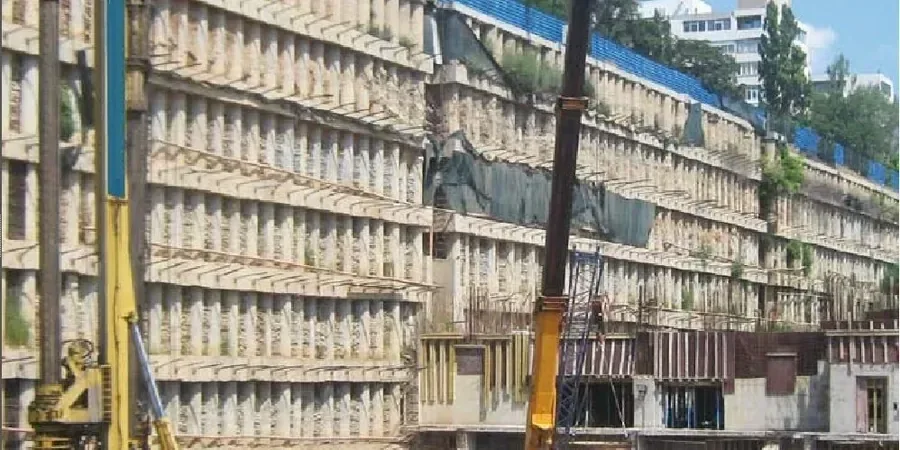
In Manchester, the contrast between sandstone bedrock and soft alluvial deposits means diaphragm wall design must be tailored to each site's unique stratigraphy.
Scope of work in Manchester
- Unconfined compressive strength of the bedrock – typically 2-8 MPa for Manchester's sandstone.
- Undrained shear strength of superficial clays – often between 30 and 90 kPa in the Irwell valley.
- Groundwater regime – the water table can sit just 2-4 m below ground in low-lying areas.
- Wall stiffness (EI) – required to limit lateral deflections to 0.2-0.5% of excavation depth.
Critical ground factors in Manchester
A hydraulic grab rig operating in Manchester's confined city-centre streets must balance production speed with precision. The risk of panel misalignment or slurry loss increases when the wall passes through granular river deposits with cobbles. We mitigate this by specifying polymer-based slurries with controlled viscosity and by monitoring trench stability with ultrasonic sensors. In areas underlain by abandoned coal workings — such as parts of east Manchester — the risk of sudden void collapse requires pre-treatment with low-mobility grout before diaphragm wall construction begins.
This service complements our laboratory testing work for a complete project analysis.
Our services
We offer a full suite of diaphragm wall activities tailored to Manchester's ground conditions and project requirements.
Structural Wall Design & Detailing
Reinforced concrete diaphragm walls designed to Eurocode 2 with serviceability checks for crack width (typically <0.3 mm) and deflection limits suited to urban excavations near listed buildings.
Groundwater Control & Seepage Analysis
Steady-state and transient flow modelling using SEEP/W to predict seepage into the excavation, with cut-off design using wall embedment or jet-grouted base slabs.
Wall Installation Support
Technical assistance during panel construction, including concrete mix design, reinforcement cage detailing, and real-time slurry monitoring to ensure trench stability in Manchester's variable soils.
Quick answers
What is the typical cost range for diaphragm wall design in Manchester?
For a medium-depth excavation (12-18 m) with moderate reinforcement, design fees typically range between £1,480 and £5,730, depending on the number of panels, complexity of ground conditions, and level of finite-element analysis required.
How deep can diaphragm walls be constructed in Manchester's sandstone?
In the city centre where competent Triassic sandstone is encountered, walls have been taken to depths of 25 m without difficulty. In the alluvial valleys, depth is limited by the thickness of soft deposits and the need to achieve adequate toe embedment into the bedrock.
What soil parameters are critical for diaphragm wall design in Manchester?
The undrained shear strength of superficial clays, the unconfined compressive strength of sandstone, and the groundwater regime are the three most critical parameters. Triaxial tests on undisturbed samples and falling-head permeability tests in boreholes are standard.