Manchester sits on a mix of glacial till, alluvial deposits along the River Irwell, and deep peat bogs in areas like Chat Moss. Soft clays and organic silts dominate many inner-city sites, especially near the former canal basins. These low-strength soils require precise measurement of undrained shear strength before any foundation design. The field vane shear test (VST) gives us that data directly in situ, without disturbing the fragile structure of the clay. We perform the test following BS 5930 and Eurocode 7, using a calibrated vane that rotates at a controlled rate. For stiff tills or granular soils we first check borehole logs and often recommend a complementary ensayo SPT to correlate blow counts with vane results.
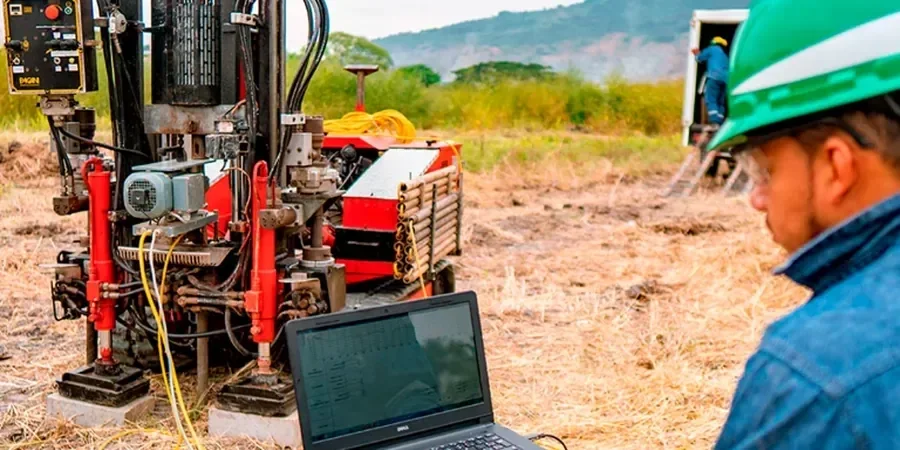
The field vane shear test (VST) is the most reliable method for measuring undrained shear strength in soft Manchester clays – it bypasses sample disturbance entirely.
Scope of work in Manchester
- Peak torque (N·m) for undrained shear strength
- Residual torque for sensitivity ratio
- Depth increments every 0.5–1.0 m
Critical ground factors in Manchester
A common mistake in Manchester is treating all clay till as the same material. Contractors often rely on pocket penetrometer readings from disturbed samples, which underestimate strength by 30–50% in soft zones. Without a field vane shear test (VST), you risk over-designing foundations in Chat Moss peat or, worse, under-designing in the stiff till overlying the Irwell floodplain. That leads to differential settlement or bearing failure. The VST bypasses sample disturbance and gives you the true undrained shear strength at every metre. We always run the test before any slab or pile design in low-strength soils.
This service complements our laboratory testing work for a complete project analysis.
Our services
We offer two complementary activities that build on the field vane shear test data.
Undrained strength profiling for shallow foundations
Using VST results at 1 m intervals, we produce a depth–strength profile for strip or pad foundations. We apply Bjerrum corrections based on plasticity index and give you allowable bearing pressures for soft clay sites across Manchester.
Sensitivity analysis for slope stability in canals
Manchester's canal network runs through soft alluvium. We combine peak and residual VST readings to calculate sensitivity (peak/residual). High sensitivity (>4) indicates quick clay behaviour – critical for slope stability assessments along the Rochdale and Ashton canals.
Quick answers
How does the field vane shear test (VST) differ from a triaxial test?
The VST measures undrained shear strength in situ, avoiding sample disturbance. A triaxial test requires undisturbed samples that soften during extraction and transport. For soft Manchester clays the VST is faster (20 minutes per test) and more reliable, though it only gives peak and residual values – it does not produce stress–strain curves.
What is the typical cost of a field vane shear test in Manchester?
The typical cost for a field vane shear test in Manchester ranges from £570 to £1,130 depending on depth, number of readings, and access conditions. This includes the vane test, Bjerrum correction, and a summary report. Additional mobilisation costs may apply for sites outside the M60 ring road.
Can the VST be performed in gravel or stiff till?
No – the vane is designed for soft clays, silts, and peats with undrained shear strength below 100 kPa. In stiff Manchester till you would break the vane rod or get unreliable torque readings. For stiff soils we recommend the SPT or a dilatometer test instead.
How do you account for plasticity in the VST results?
We apply the Bjerrum correction factor (μ) based on plasticity index. For low-plasticity clays (PI < 20%) μ is close to 1.0. For high-plasticity clays (PI > 40%) μ drops to about 0.6. We always measure PI on adjacent samples from the same borehole to apply the correct factor.