Manchester sits on a mixed geological sequence of glacial till, fluvial sands, and alluvial clays deposited by the River Irwell and its tributaries. The city centre alone sees groundwater levels fluctuating between 2 and 5 metres below street level, which directly affects how we interpret dilatometer readings in fine-grained soils. When we carry out a Flat Dilatometer Test (DMT) in Manchester, we focus on the undrained shear strength and horizontal stress index – parameters that govern lateral earth pressures on basement walls and piled foundations. In our knowledge, the DMT gives more consistent results than the SPT in soft to firm clays because it measures the soil’s response in situ without the disturbance caused by hammer-driven samplers. Before we deploy the blade, we always cross-check with a resistivity survey to map the stratigraphy along the probe line, especially when working near the Manchester Ship Canal where buried channels create abrupt changes in soil type.
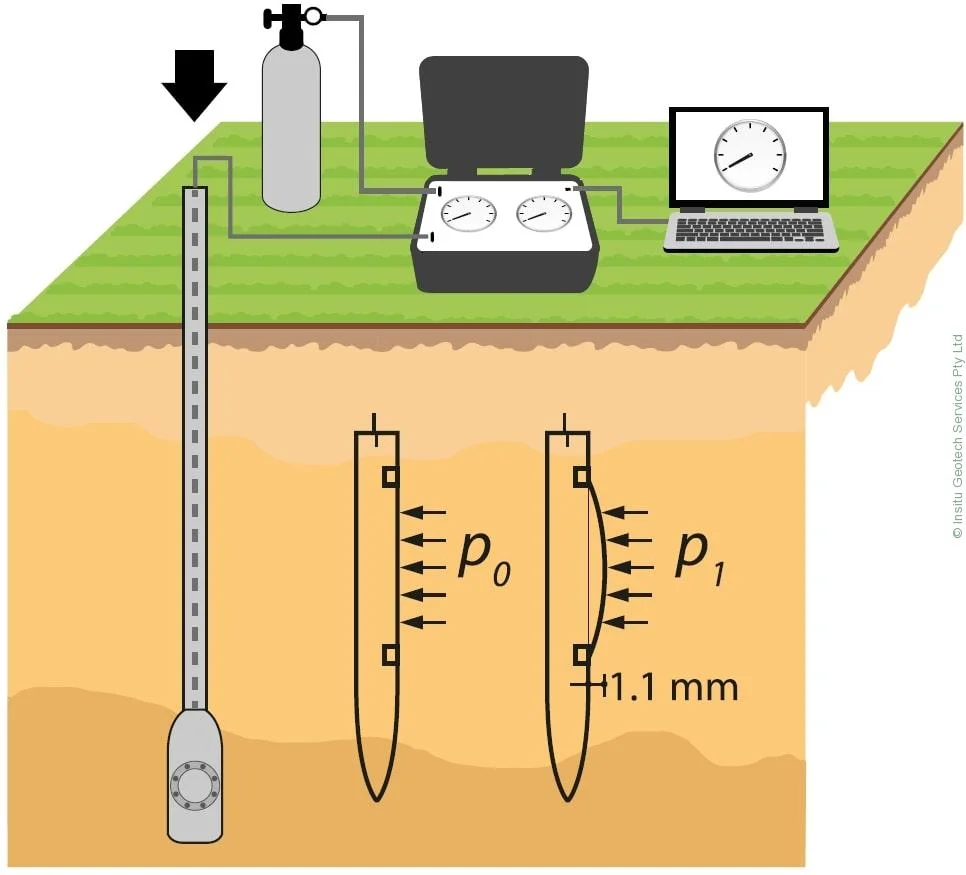
In Manchester’s till and alluvial clays, the DMT’s continuous profile reveals horizontal stress changes that a borehole log alone would miss entirely.
Scope of work in Manchester
Working video
Critical ground factors in Manchester
The North West’s high annual rainfall – Manchester averages 867 mm per year – keeps the water table high in the glacial till, which can cause the dilatometer blade to encounter artesian pressures in confined sand lenses. If the membrane inflates against a saturated sand layer, the reading may reflect pore pressure dissipation rather than true soil stiffness, leading to an overestimate of the modulus. We mitigate this by monitoring the pressure decay curve for 60 seconds after each inflation and comparing it with the theoretical A- and B-readings. In areas like the Medlock Valley, where peat lenses are common, the DMT’s KD index can drop below 1.5, indicating a soft, compressible layer that would trigger differential settlement if not treated. In such cases we recommend a preloading scheme combined with vertical drains before any structural load is applied.
This service complements our laboratory testing work for a complete project analysis.
Our services
We offer a full suite of Flat Dilatometer Test activities tailored to Manchester’s ground conditions, from preliminary site characterisation to detailed design parameters.
Standard DMT Sounding
Continuous profiling at 20 cm intervals to depths up to 30 metres. Suitable for soft to medium clays, silts, and sands. Includes field calibration, real-time data acquisition, and a report with ID, KD, and ED profiles.
Seismic DMT (SDMT)
Incorporates a geophone at the blade to measure shear wave velocity (Vs) at each test depth. Provides small-strain stiffness (G0) for dynamic analyses and soil classification for earthquake design.
Dissipation Testing
Monitors pore pressure decay after blade insertion in clay layers. Determines coefficient of consolidation (ch) and in-situ permeability. Essential for embankment stability and consolidation analysis on the Manchester alluvial plains.
Combined DMT & Borehole Investigation
Integrates DMT soundings with rotary core drilling and undisturbed sampling. We correlate the dilatometer parameters with laboratory triaxial and oedometer tests to produce site-specific design correlations for raft and pile foundations.
Quick answers
What is the Flat Dilatometer Test (DMT) and what does it measure?
The DMT is an in-situ test that measures the lateral stress required to inflate a steel membrane against the borehole wall. From the inflation pressures we derive the material index (ID), horizontal stress index (KD), and dilatometer modulus (ED). These are used to estimate undrained shear strength, constrained modulus, and coefficient of consolidation in fine-grained soils.
How much does a Flat Dilatometer Test cost in Manchester?
For a standard DMT sounding to 20 metres depth, the typical cost ranges between 680 and 830 GBP, including mobilisation within Greater Manchester, field execution, and a basic interpretation report. Costs increase for seismic DMT (SDMT) or dissipation testing, and for projects requiring multiple soundings the per-point rate decreases.
How does the DMT compare to the CPT for Manchester soils?
The DMT is better suited to stiff overconsolidated tills and layered alluvium because it measures horizontal stress directly, which the CPT cone cannot do. In Manchester’s glacial till, the DMT’s KD index is more sensitive to overconsolidation than the CPT’s friction ratio. However, the CPT gives a faster, continuous penetration rate and is preferred for deep soft clays where pore pressure dissipation is the priority.
Can the DMT be used to design pile foundations in Manchester?
Yes. The DMT provides the horizontal subgrade reaction modulus (kh) and the undrained shear strength (Su) needed for lateral pile capacity calculations. In Manchester’s till, we typically see Su values of 80–150 kPa from the DMT, which correlate well with pressuremeter tests. We recommend using the DMT in combination with a pile load test to calibrate the empirical coefficients.