Manchester's 1,400 mm annual rainfall and high water table create a landscape where soil permeability dictates everything from basement waterproofing to pavement drainage. A laboratory permeability test using falling or constant head methods gives us the hydraulic conductivity coefficient (k) needed for informed design. We follow BS 5930 for sample preparation and BS EN 1997-1:2004 for partial factor application. Before tackling foundation drainage or slope stability, we often recommend combining this with a permeability field test to correlate lab results with in-situ conditions.
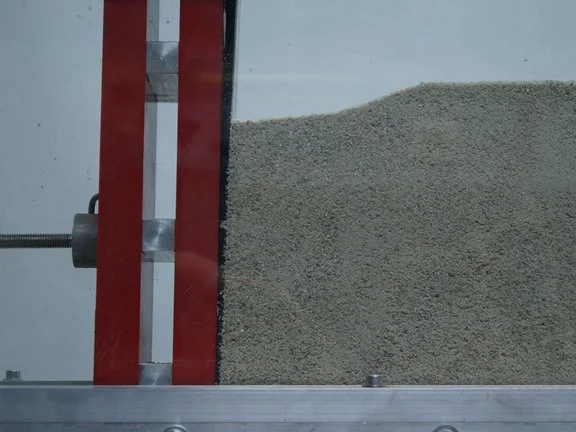
A single k-value from a falling head test can prevent decades of drainage failure in Manchester's clay-rich till deposits.
Scope of work in Manchester
Critical ground factors in Manchester
The permeameter cell itself demands careful setup. A single air bubble trapped in the outflow line can halve the measured k-value, leading to undersized drainage systems. We degas all water under vacuum and use back-pressure saturation to ensure 100% saturation before testing. In Manchester, where glacial tills often contain lenses of coarse sand, one misidentified layer in the lab can cause a factor-of-ten error in field-scale flow predictions. That is why we always correlate laboratory permeability tests with in-situ consolidation data from adjacent boreholes.
This service complements our laboratory testing work for a complete project analysis.
Our services
We offer two complementary laboratory permeability activities tailored to Manchester's diverse soil profiles:
Falling head permeability (fine-grained soils)
Designed for silts and clays with k < 10⁻⁶ m/s. Uses a standpipe and graduated burette to measure flow under a decreasing head. Ideal for consolidation settlement analysis and clay liner design.
Constant head permeability (granular soils)
For sands and gravels with k > 10⁻⁴ m/s. Water is passed through the sample at a steady hydraulic gradient. Essential for filter design, dewatering planning, and drainage layer specification.
Quick answers
What is the difference between falling head and constant head tests?
Falling head tests measure permeability of fine soils (clays, silts) where flow is slow; a water column drops over time. Constant head tests suit coarse soils (sands, gravels) with rapid flow; water level is kept constant, and outflow volume is measured directly.
How long does a laboratory permeability test take in Manchester?
For a standard falling head test on clay, expect 5–10 working days including sample preparation and saturation. Constant head tests on sands are faster, typically 3–5 working days. Rush activities are available for critical path projects.
Do you test undisturbed samples or remoulded samples?
We test both. Undisturbed U100 or thin-wall tube samples give the most representative k-value for in-situ conditions. Remoulded samples are used for compaction quality control or when testing borrowed fill materials.
What is the typical cost of a permeability test in Manchester?
A single laboratory permeability test (falling or constant head) typically costs between £300 and £450, depending on sample type and urgency. Bulk discounts apply for multiple samples from the same site.