Manchester's weather is famously wet, with over 800 mm of rain annually saturating the ground and complicating foundation work. After decades of industrial use, the city's subsurface is a patchwork of glacial till, alluvial silts, and made ground from Victorian fill. For sites near the Irwell or Medlock, groundwater sits just a few metres down, which makes conventional piling noisy and disruptive in tight city blocks. That's where micropile design becomes essential: these small-diameter, high-capacity elements can be installed with low-vibration rigs in confined spaces, threading through old foundations and rubble without destabilising adjacent structures. Before we finalise any micropile layout, we always run a permeability test in the field to understand water flow through the granular layers, because seepage can drastically alter grout take and bond stress along the pile shaft.
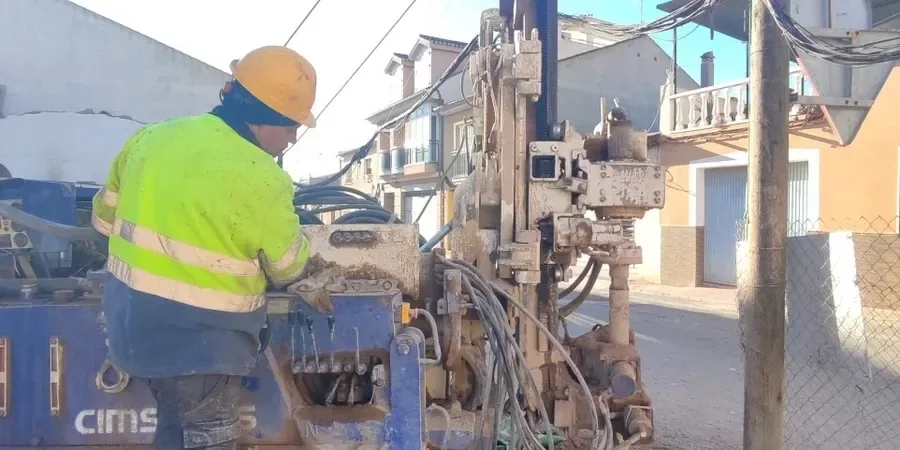
For Manchester's brownfield sites, micropiles eliminate the need for deep excavations and keep vibration below 2 mm/s – critical near listed buildings.
Scope of work in Manchester
Working video
Critical ground factors in Manchester
Eurocode 7 (BS EN 1997-1:2004) demands that micropile design accounts for both structural and geotechnical limit states, and in Manchester the main risk is variable ground conditions within a single site. A borehole 10 metres away can show completely different SPT profiles, especially where old cellars or mill foundations remain undocumented. We mitigate this by specifying preliminary test piles on at least two per cent of the working piles, with static load tests to 1.5 times the design load. Without that verification, bond stress assumptions can be wildly optimistic in the laminated glacial clays typical of the region. Groundwater control is another risk: perched water in the fill above the till can wash out fresh grout if casing is withdrawn too early.
This service complements our laboratory testing work for a complete project analysis.
Our services
We offer two complementary activities to support micropile design in Manchester, each adapted to the local ground conditions and project constraints.
Preliminary Test Pile Installation & Load Testing
We install sacrificial test piles at representative locations, instrumented with strain gauges along the shaft, and perform maintained-load tests to verify bond stress and overall capacity. The results feed directly into the final design parameters, reducing over-design and programme risk.
Micropile Design for Brownfield Sites
For contaminated or obstructed ground, we design micropile arrays that bypass buried obstructions and resist both vertical and lateral loads. Each design includes a corrosion protection specification (BS EN ISO 12944) and a grout mix tailored to the groundwater chemistry found on site.
Quick answers
How does micropile design differ in Manchester's glacial till versus other UK soils?
Glacial till in Manchester is typically a stiff, fissured clay with cobbles and boulders, which gives good shaft friction but makes drilling unpredictable. We use continuous flight augers with rock tools to handle the cobbles, and we limit bond stress to 80-120 kPa in the till unless test piles prove higher values. In softer alluvial soils we rely entirely on the socket into the underlying sandstone for capacity.
What is the typical cost range for a micropile design project in Manchester?
For a medium-sized residential or commercial project in Manchester, expect total design and testing costs between £1.240 and £3.690, depending on the number of test piles, ground investigation data available, and structural load requirements. This includes preliminary design, load testing, and final report with drawings.
Can micropiles be installed near Manchester's historic buildings without damage?
Yes. Micropiles produce very low vibration (typically below 2 mm/s peak particle velocity), which is well within the safe threshold for Grade I and II listed structures common in Manchester's city centre. We also use continuous casing through the upper layers to prevent soil loss or settlement beneath adjacent foundations.
What ground investigation data do you need before starting micropile design in Manchester?
At minimum, we require boreholes to at least 5 metres below the proposed pile toe depth, with SPT values every metre, groundwater monitoring, and laboratory tests for shear strength and soil classification. For sites on made ground or old industrial fill, we also recommend a trial pit to map obstructions before finalising the micropile layout.