The difference between building on the Sherwood Sandstone that underlies the city centre and the glacial till found across much of south Manchester is substantial for foundation design. On Deansgate, we routinely see weathered sandstone providing bearing capacities above 600 kPa, while just a few miles south in Didsbury the glacial till can drop to 250 kPa with significant cobble content. Between these two extremes lie the alluvial deposits along the River Irwell and the made ground from Manchester's industrial past around Ancoats. This variability makes the plate load test a critical tool before determining allowable bearing pressures. We combine this direct measurement with a georradar survey to identify buried obstructions or old foundations before mobilising the reaction load.
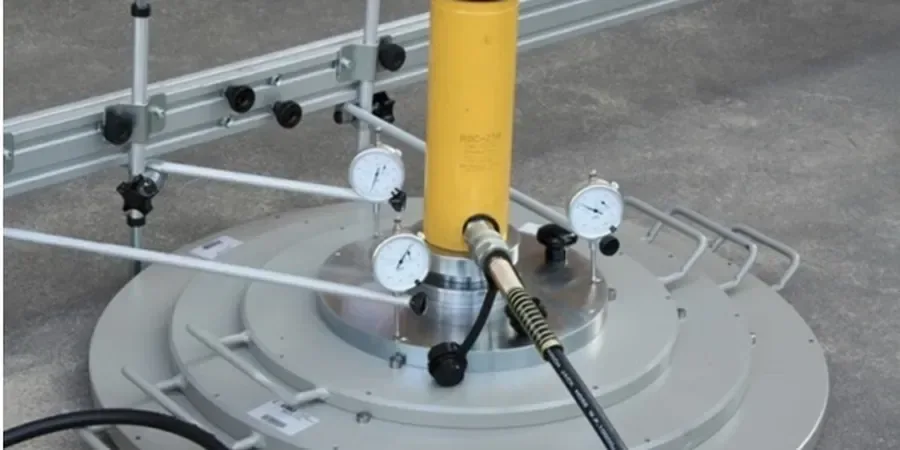
A single plate load test on Manchester's glacial till can reduce foundation overdesign by 30% compared to relying on desk-study bearing values alone.
Scope of work in Manchester
Critical ground factors in Manchester
A common mistake among contractors working on Manchester's brownfield sites is jumping straight to a design bearing pressure based on published values from the British Geological Survey maps without verifying them locally. The made ground along the Rochdale Canal corridor, for instance, can vary from compacted demolition rubble to loose ash fill within the same plot. Without a plate load test, the risk of differential settlement between adjacent footings becomes unacceptably high. We have seen cases where a raft foundation was designed for 150 kPa only for the test to reveal a localised zone of only 90 kPa, requiring a redesign to deep piles or Improvement.
This service complements our laboratory testing work for a complete project analysis.
Our services
Our plate load testing in Manchester is backed by complementary activities for a complete foundation assessment.
Reaction-Plate Load Tests (PLT)
We perform maintained-load plate tests using a 600 mm or 300 mm circular plate with either a 30-tonne excavator or kentledge blocks as reaction. Test cycles include seating, load increments to 1.5x design stress, and a 24-hour creep stage where required. Suitable for shallow foundations and pavement subgrades.
Cyclic Plate Load Tests
For pavement and railway applications, we apply up to 10,000 load cycles at frequencies from 0.5 Hz to 3 Hz to simulate traffic loading. The resilient modulus and permanent deformation are recorded. This test is particularly relevant for Manchester's tram (Metrolink) extension projects across soft alluvium.
Quick answers
How does a plate load test differ from an SPT in Manchester soils?
The SPT measures a dynamic penetration resistance (N-value) at discrete depths, while the plate load test applies a static load directly at foundation level and measures settlement in real time. In Manchester's glacial till, the SPT may overestimate bearing capacity due to cobble interference, whereas the PLT provides a direct load-settlement curve at the actual footing elevation.
What is the typical cost range for a plate load test in Greater Manchester?
The cost ranges between £640 and £1,140 depending on the reaction system required, site access constraints, and the number of test locations. Kentledge setups in restricted city-centre sites tend toward the upper end, while open sites with excavator access are at the lower end.
Which Manchester ground conditions require a cyclic plate load test?
Cyclic PLT is recommended for pavements on the alluvial deposits along the Mersey Valley, where repeated loading from heavy traffic can cause progressive settlement. The test is also specified for Metrolink trackbed designs on soft ground around Trafford Park and Salford Quays.
How long does a plate load test take from mobilisation to report?
A single test on a maintained-load cycle takes one full day on site, plus two working days for data analysis and a certified report. Cyclic tests require two to three days on site depending on the number of cycles. We typically complete the full process within five working days.