We recently worked on a six-story student accommodation block near the University of Manchester campus. The site sat on a thick layer of glacial till overlying sandstone, but historical maps showed a former mill pond had been backfilled with rubble and ash. That made ground demanded a stiff raft foundation to bridge variable bearing layers and limit differential settlement. A raft spreads the load across the entire footprint, reducing stress on the weaker spots. Before committing to the slab geometry, we ran a placa de carga at two locations to validate the design modulus. The results guided both the raft thickness and the reinforcement layout.
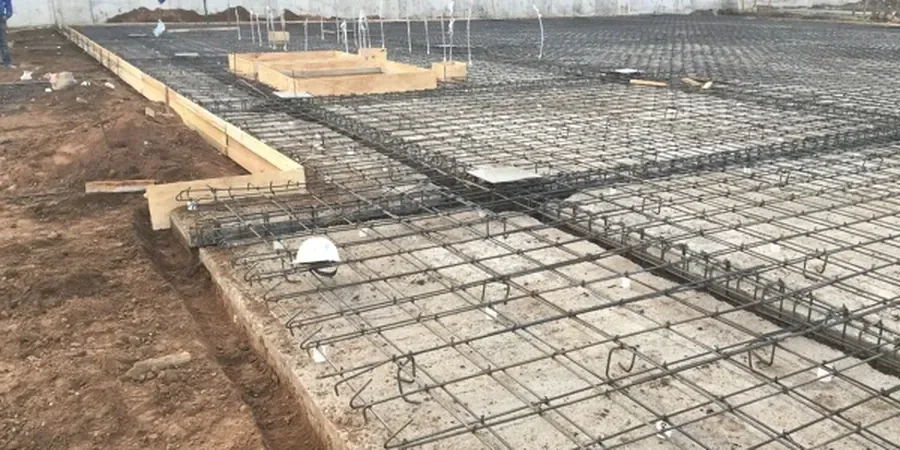
A properly designed raft foundation in Manchester's variable ground can reduce differential settlement by over 60% compared to isolated pads.
Scope of work in Manchester
- Allowable bearing capacity under service loads (typically 100–250 kPa for till)
- Modulus of subgrade reaction for slab design (k-values from 20 to 60 MN/m³)
- Differential settlement limits (often 25 mm for reinforced concrete frames)
- Uplift resistance in high groundwater zones near the River Irwell
Working video
Critical ground factors in Manchester
Manchester sits on the Lancashire Coal Measures, with abundant old mine workings beneath parts of the city centre. The Coal Authority records show over 400 recorded mine entries within the M60 ring road. A raft foundation must account for potential subsidence from shallow workings. We review historical mining plans and often recommend a void detection survey before finalising the raft layout. Without this step, a hidden void can cause a sudden loss of support under the slab, leading to cracking in the superstructure. The raft's stiffness becomes critical here: it must span potential voids without overstressing the concrete.
This service complements our laboratory testing work for a complete project analysis.
Our services
Our raft/mat foundation design service in Manchester covers the full geotechnical chain, from site investigation to final slab specification. We tailor each stage to the local ground conditions.
Geotechnical Site Investigation
Boreholes, trial pits, and In-Situ to profile strata, measure groundwater, and obtain undisturbed samples for lab testing. We follow BS 5930 and use dynamic sampling in till to avoid smearing.
Bearing Capacity & Settlement Analysis
We calculate ultimate and serviceability limit states using Eurocode 7. The analysis includes immediate settlement in sands and consolidation in clays, plus long-term creep where peat is present.
Raft Slab Detailing & Reinforcement Design
Based on the geotechnical parameters, we specify slab thickness, reinforcement ratios, and joint locations. We also check punching shear at column locations and thermal crack control per CIRIA C660.
Quick answers
When is a raft foundation better than strip footings in Manchester?
A raft is preferred when bearing capacity is low or variable across the site, or when differential settlement must be tightly controlled. In Manchester's made ground zones, a raft bridges weak spots that would cause excessive settlement under isolated footings.
What ground conditions in Manchester require a raft foundation?
Sites with soft alluvial clays, peat, or shallow mine workings typically need a raft. We also recommend rafts where groundwater is high and uplift forces could lift a shallow foundation. The glacial till itself is competent, but the overlying made ground often creates the need.
How does the raft design account for mining subsidence?
We review Coal Authority records and historical mine plans. If shallow workings are identified, we design the raft with additional reinforcement and a thicker slab to span potential voids. In extreme cases, we specify a reinforced concrete grid with deeper beams.
What is the typical cost range for a raft foundation design in Manchester?
The cost for a full geotechnical assessment and raft design typically falls between £940 and £3,500, depending on site complexity, number of boreholes, and lab testing volume. The final cost is confirmed after the site walkover.