A site in Didsbury might sit on deep, clay-rich residual soil weathered from the underlying Mercia Mudstone, while a plot in the city centre often bears on made ground over glacial till. That contrast between Manchester's eastern suburbs and its post-industrial core is exactly why we rely on residual soil characterization before any foundation design. The weathered mantle here can vary from a stiff silty clay to a weak sandstone-like horizon within a few metres, and understanding that profile makes the difference between a safe shallow foundation and a costly deep solution. In our knowledge, combining field inspection with laboratory permeability testing gives the clearest picture of how these soils will behave under load.
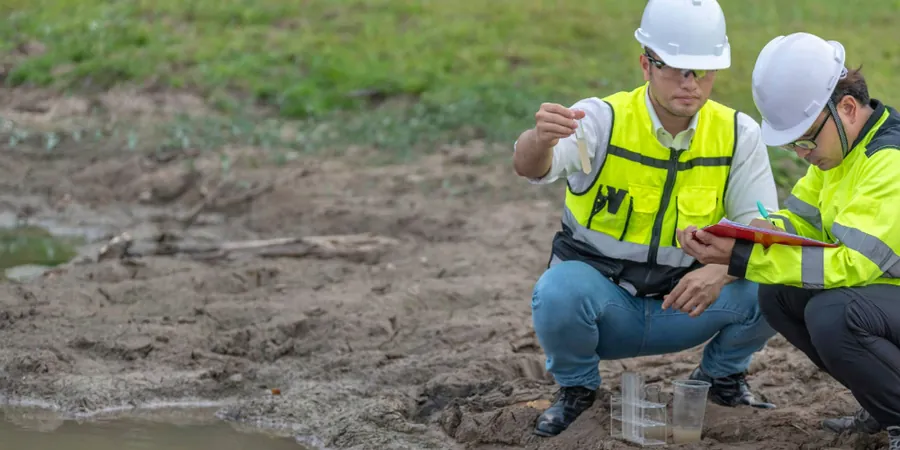
Residual soils in Manchester can vary from stiff clay to weak sandstone within metres; proper characterisation prevents overdesign and foundation failure.
Scope of work in Manchester
Critical ground factors in Manchester
A four-storey residential block we worked on in Withington had a residual soil profile that looked uniform in trial pits, but beneath the top 1.5 m of stiff clay we hit a softened zone with relict bedding planes dipping at 25 degrees. The contractor had already priced for a strip footing. We ran additional shear box tests and slope stability analysis under Eurocode 7 and found the factor of safety dropped below 1.3 under saturated conditions. The design had to shift to a reinforced raft and improved drainage. That kind of hidden heterogeneity — inherited from the parent rock structure — is the real risk in residual soil characterisation when you skip detailed profiling.
This service complements our laboratory testing work for a complete project analysis.
Our services
We offer two focused activities for residual soil characterisation in Manchester, covering both field and laboratory stages.
Field Investigation & Sampling
Trial pitting, undisturbed block sampling, and in-situ shear vane testing at depths of up to 4 m. We log weathering grades per BS 5930 and collect samples for index and strength tests.
Laboratory Characterisation & Reporting
Full suite of index tests (moisture content, Atterberg limits, particle density), triaxial compression (UU and CU), and oedometer consolidation. We deliver a characterisation report with design parameters and recommendations.
Quick answers
Why is residual soil characterisation important for construction in Manchester?
Because the weathered Mercia Mudstone and Coal Measures form soils that look uniform but contain relict structure, fissures, and variable strength. Without proper characterisation, foundation designs either overestimate capacity or fail to account for softening zones, leading to differential settlement or slope instability.
What is the typical cost range for a residual soil characterisation study in Manchester?
For a standard residential or small commercial site, the cost typically falls between £620 and £2,280 depending on the number of trial pits, laboratory tests required, and reporting depth. We can offer a fixed quote after reviewing the site scope.
Which British standards apply to residual soil characterisation in the UK?
BS 5930:2015 is the main code for ground investigation procedures, including logging of weathering grades. Eurocode 7 (EN 1997-1:2004) governs the geotechnical design based on the characterisation results. Sampling must follow BS EN ISO 22475-1:2006.
How long does a full residual soil characterisation take from sampling to report?
Typically 10 to 15 working days from the start of fieldwork. This includes trial pitting, sampling, laboratory testing (index, triaxial, oedometer), and preparation of the final characterisation report with design parameters.