Manchester sits on a varied geology that directly affects how seismic waves behave near the surface. On many projects we find bedrock overlain by thick deposits of glacial till, alluvium, and made ground, each with its own stiffness and damping properties. A standard code check often misses local amplification, so we run a dedicated seismic amplification analysis to capture the actual ground motion at a given site. This matters for schools, hospitals, and high-rise towers where the dynamic response of the soil column can double or triple the peak acceleration. Before that, we often coordinate a microtremor HVSR survey to define the fundamental frequency of the site, which feeds directly into the amplification model.
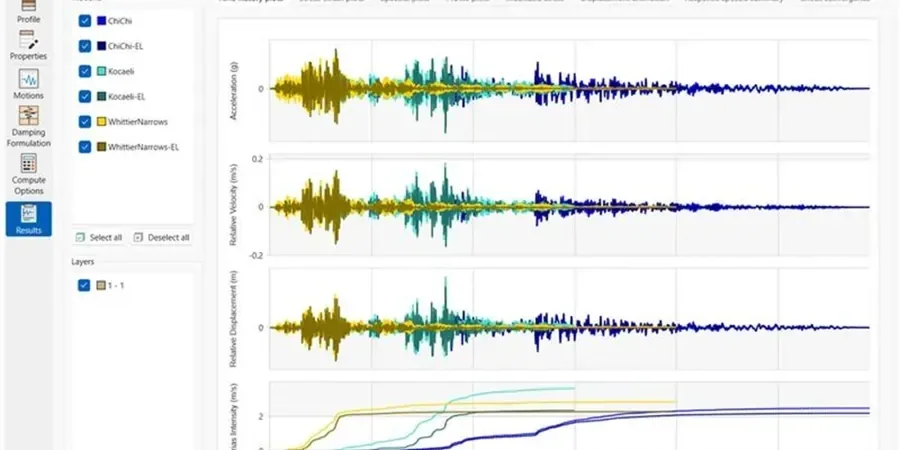
A soil column that looks stiff in a borehole can still amplify motion if its natural frequency matches the building's fundamental period.
Scope of work in Manchester
Critical ground factors in Manchester
We see the highest risk in areas where soft alluvial deposits overlie stiff glacial till, a common condition along the River Irwell and the Mersey Valley. The impedance contrast between these layers can create a sharp amplification peak at the site's natural frequency. If a building's fundamental period falls in that range, the seismic demand can exceed code-minimum values by a significant margin. Ignoring this effect has led to unexpected damage in past UK earthquakes, even at moderate magnitudes. For critical structures, we always recommend a site-specific amplification analysis rather than relying on generic soil factors.
This service complements our laboratory testing work for a complete project analysis.
Our services
Our seismic activities in Manchester cover the full chain from field investigation to final design spectra. Each component is tailored to the site's geology and the project's risk level.
MASW Survey & VS30 Profiling
Active and passive surface-wave array to map shear-wave velocity down to 30 m. Output includes site class per Eurocode 8 and Vs profile for numerical modeling.
Resonant Column & Cyclic Triaxial Tests
Laboratory determination of G/Gmax reduction curves and damping ratio at small to medium strains. Essential for nonlinear deformation analysis.
Equivalent-Linear & Nonlinear Site Response
One-dimensional wave propagation analysis using DeepSoil. We offer acceleration time histories and response spectra at the ground surface.
Liquefaction Triggering Assessment
SPT- and CPT-based evaluation of cyclic resistance ratio for saturated sands in Manchester's river valleys. Includes post-liquefaction settlement estimates.
Quick answers
When is a seismic amplification analysis required in Manchester?
It is typically required for buildings in Importance Class II and above, especially those with irregular geometry, long spans, or sensitive equipment. The UK National Annex to Eurocode 8 also recommends it for sites where the soil profile varies significantly over depth or where soft layers exceed 5 m thickness.
How much does a seismic amplification analysis cost?
For a standard site in Manchester, the cost ranges between £940 and £1,550 depending on the number of boreholes, the depth of the MASW survey, and the complexity of the numerical model. This includes field work, lab tests, and a full report with design spectra.
What is the difference between VS30 and site-specific amplification?
VS30 is a simplified single value that classifies the entire site into a generic soil category. Site-specific amplification analysis accounts for the actual layering, stiffness contrast, and damping of each stratum. In Manchester's variable ground, the site-specific approach can predict double the acceleration compared to the code generic factor.