Manchester sits on a varied geology of glacial till, alluvial deposits, and Coal Measures bedrock. With over 550,000 residents and ongoing infrastructure expansion from Salford Quays to the Airport Relief Road, slope failures in cuttings and embankments are a real concern. Our slope stability analysis evaluates failure surfaces under drained and undrained conditions using limit equilibrium and finite element methods. We assess pore pressure regimes, shear strength parameters, and seismic loading per Eurocode 7. For urban sites near the Manchester Ship Canal, we complement the study with monitoreo de taludes to track real-time movement. Every project begins with a desk study of BGS records, then targeted ground investigation to obtain undisturbed samples for Triaxial and direct shear testing.
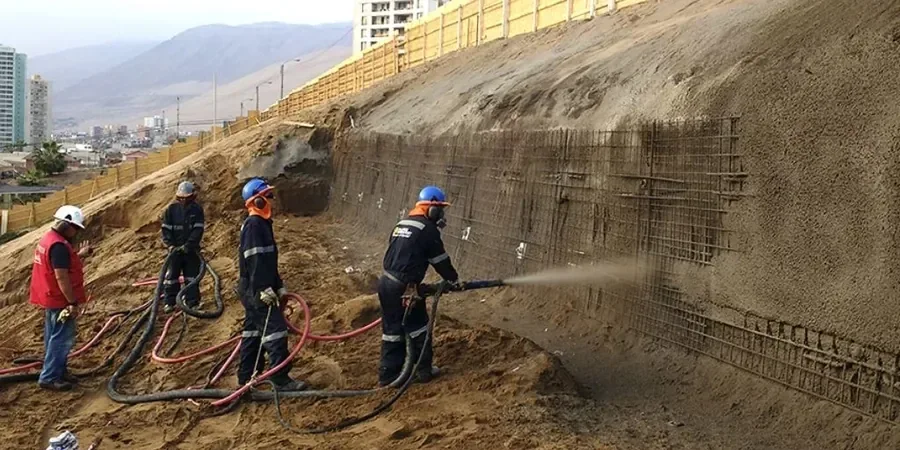
Rainfall infiltration is the primary trigger for shallow landslides in Manchester's glacial till, requiring careful pore pressure modelling.
Scope of work in Manchester
Critical ground factors in Manchester
Our field team uses tracked excavators to cut inspection trenches up to 4 metres deep where access allows. For steeper terrain near the M60 embankments, we deploy hand augers and window samplers to retrieve disturbed and undisturbed samples. The main risk in Manchester's slopes is undrained failure during excavation in soft alluvial clays. We monitor standpipe piezometers weekly and adjust the analysis if pore pressures exceed modelled values. A sudden rise after heavy rain can reduce the factor of safety below 1.0 within hours. Our reports include contingency measures such as drainage trenches or soil nailing if the calculated safety margin is borderline.
This service complements our laboratory testing work for a complete project analysis.
Our services
We offer a full suite of slope stability activities tailored to Manchester's geology and urban context.
Limit Equilibrium Analysis
Bishop, Janbu, and Morgenstern-Price methods for circular and non-circular slip surfaces. Includes sensitivity analysis for water table variation and surcharge loads.
Finite Element Modelling
2D FEM using Slide and Plaxis to model strain-softening, staged construction, and reinforcement interaction with soil nails or geogrids.
Ground Investigation for Slopes
Boreholes, trial pits, and In-Situ (SPT, vane shear, piezometers) to derive design parameters for each soil layer.
Quick answers
What is the typical cost of a slope stability analysis in Manchester?
For a straightforward cutting or embankment with 3-5 boreholes and limit equilibrium analysis, the cost ranges between £930 and £3,360 depending on site access, depth, and the number of failure surfaces modelled.
How long does a slope stability study take?
A standard study takes 3 to 5 weeks from desk study to final report. Complex sites with FEM modelling or long-term piezometer monitoring can extend to 8 weeks.
What standards apply to slope stability in the UK?
Eurocode 7 (EN 1997-1) is the design standard. Site investigation follows BS 5930, and shear strength testing follows BS 1377. For temporary works, CIRIA C760 provides additional guidance.
When should I commission a slope stability analysis?
Before any excavation deeper than 1.5 m, for new embankments, or if existing slopes show tension cracks, bulging, or seepage. Planning conditions often require it for developments near steep ground or watercourses.