Manchester sits on a complex mix of glacial till, fluvial sands and soft alluvial clays along the Irwell and Medlock valleys. The water table often sits within 2–3 m of the surface, especially around the city centre and Salford Quays. A proper soil mechanics study here must account for these layered deposits, because bearing capacity can shift dramatically within a single site. We correlate borehole logs with a plate load test to verify design assumptions before we issue final parameters. Our team has logged hundreds of trial pits across Greater Manchester and understands how the underlying Sherwood Sandstone controls deep foundation behaviour.
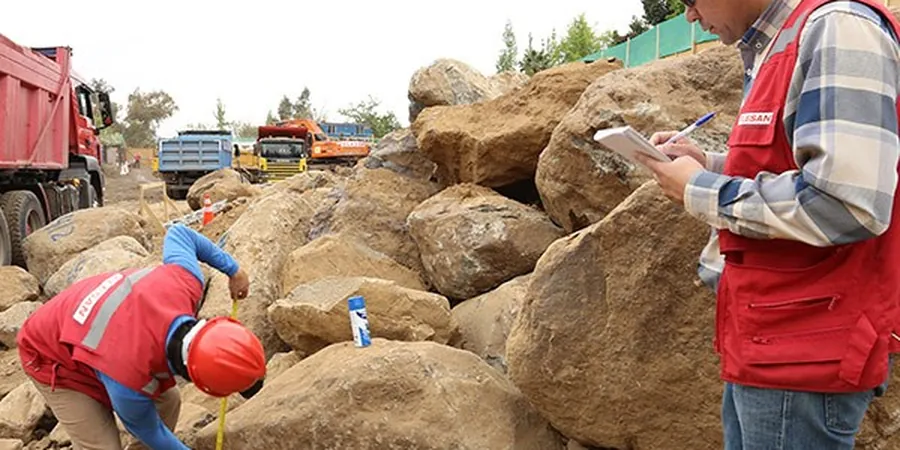
Glacial till in Manchester can vary from stiff clay to dense sandy gravel within 2 m — a single borehole never tells the whole story.
Scope of work in Manchester
- Rotary core drilling through till to recover undisturbed samples for triaxial testing
- Standard Penetration Tests at 1.0 m intervals in granular strata
- Laboratory classification: moisture content, Atterberg limits, particle size distribution
Working video
Critical ground factors in Manchester
The most common mistake we see in Manchester is assuming the glacial till behaves uniformly across a site. Developers often take one borehole and extrapolate the bearing resistance for the whole footprint. But till lenses can pinch out laterally, leaving soft zones that cause differential settlement under strip footings. Without a soil mechanics study that includes multiple test pits and geophysical profiling, you risk cracking superstructures and costly remedial grouting later. The clay layers beneath Deansgate are especially prone to this behaviour.
This service complements our laboratory testing work for a complete project analysis.
Our services
We structure our soil mechanics study around three core activities that address Manchester's ground conditions directly.
Rotary Core Drilling & SPT
Continuous core recovery through till and bedrock, with SPT at 1.0 m intervals. Samples sent for classification, triaxial and oedometer testing.
Trial Pitting & Logging
Machine-excavated pits up to 4.5 m deep for direct visual inspection of soil fabric. We log in accordance with BS 5930 and take bulk disturbed samples.
Groundwater Monitoring
Installation of Casagrande standpipes or vibrating-wire piezometers. Weekly monitoring over three months to establish peak water levels for basement design.
Quick answers
How long does a soil mechanics study take in Manchester?
A typical study for a residential development takes 4 to 6 weeks from site visit to final report. Complex sites with deep alluvium can extend to 10 weeks depending on groundwater monitoring duration.
What is the cost range for a soil mechanics study in the Manchester area?
For a standard 4-borehole investigation with full laboratory testing, the cost ranges between £2,680 and £4,090. Larger sites with multiple trial pits or long-term monitoring fall at the higher end.
Do I need a soil mechanics study for a single house extension in Manchester?
It depends on ground conditions. If you are building on the alluvial floodplain or near the Rochdale Canal, we recommend at least a trial pit and a couple of SPTs to confirm bearing capacity and avoid differential movement.