Manchester's shallow geology is a mix of glacial till (boulder clay) overlying the Manchester Marls. The till is dense, sandy clay with occasional gravel. Its natural moisture content often sits near the plastic limit. That makes compaction control critical. A Proctor test determines the maximum dry density (MDD) and optimum moisture content (OMC) for this material. Without it, fill placed on sites like Salford Quays or the Medlock Valley can settle unevenly. We follow BS 1377-4 for both Standard and Modified energy levels. The Modified Proctor is better for heavy traffic loads or deep fills. We combine this with a subgrade bearing capacity test to verify performance after compaction.
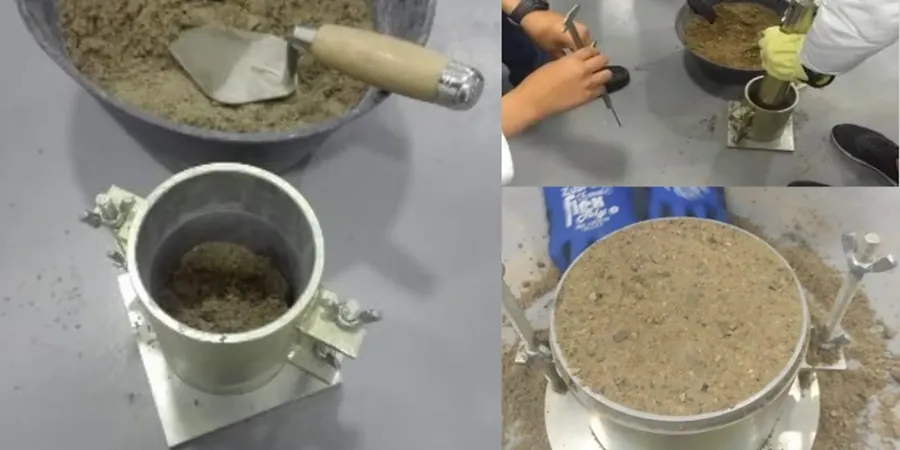
A Proctor test on Manchester's boulder clay typically yields an MDD of 1.95 Mg/m³ at 13% OMC, critical for fill specifications.
Scope of work in Manchester
Critical ground factors in Manchester
The main risk is using the wrong energy level. A Standard Proctor on a fill designed for heavy truck loading will under-compact. The result is post-construction settlement. In Manchester, old mine workings and buried foundations add variability. The Proctor test only measures remoulded soil. It does not capture in-situ fabric or cemented layers. We always pair the test with a density cone test on site. This checks the achieved compaction against the laboratory curve. Ignoring the OMC window leads to brittle fill or pumping under rollers.
This service complements our laboratory testing work for a complete project analysis.
Our services
We offer a full suite of laboratory compaction activities for Manchester projects. Each test is tailored to the material type and end use.
Standard Proctor Test
Determines MDD and OMC for general fill and light-traffic subgrades. Uses 2.5 kg rammer. Suitable for most Manchester till.
Modified Proctor Test
Higher energy for heavy-duty fills, road bases, and embankments. Uses 4.5 kg rammer. Required for highways and industrial floors.
Oversize Particle Correction
When the sample contains >20% retained on the 20 mm sieve, we apply BS 1377 correction. Common in Manchester's made ground.
One-Point Proctor (Rapid Method)
For quick field checks. Uses a single compaction point. Calibrated against the full curve. Useful for large earthworks with uniform material.
Quick answers
What is the difference between Standard and Modified Proctor in BS 1377?
The difference is the compactive effort. Standard Proctor uses a 2.5 kg rammer in three layers, giving 596 kJ/m³. Modified uses a 4.5 kg rammer in five layers, delivering 2685 kJ/m³. Modified is used for heavy traffic loads and deep fill.
How much does a Proctor test cost in Manchester?
The cost ranges between £80 and £160 per test. Prices vary with the number of points, oversize correction, and whether it is Standard or Modified. Volume discounts apply for multiple samples from the same site.
Do I need a Proctor test for a residential extension in Manchester?
Not always. Small extensions on existing foundations often skip it. But if you are placing new fill more than 600 mm deep, yes. Building control or the structural engineer may specify it to commit to compaction standards.