The difference between Manchester's city centre and the suburban areas like Didsbury or Chorlton is not just in property prices. Underneath the paved streets of the city centre, you often find dense glacial till and sandstone, offering relatively high bearing capacities. Move a few miles south to the Mersey Valley floodplain, and you encounter soft alluvial clays and peat layers that demand a completely different foundation strategy. That is why we rely on the Standard Penetration Test to deliver site-specific soil parameters across Manchester. Whether your project sits on the solid bedrock of the northern districts or the compressible deposits near the river, the SPT provides the N-values needed for safe and economical design. Before any footing is poured or pile driven, we perform this test to correlate directly with BS 5930 and Eurocode 7 requirements, ensuring your foundation engineer has the data they need from day one.
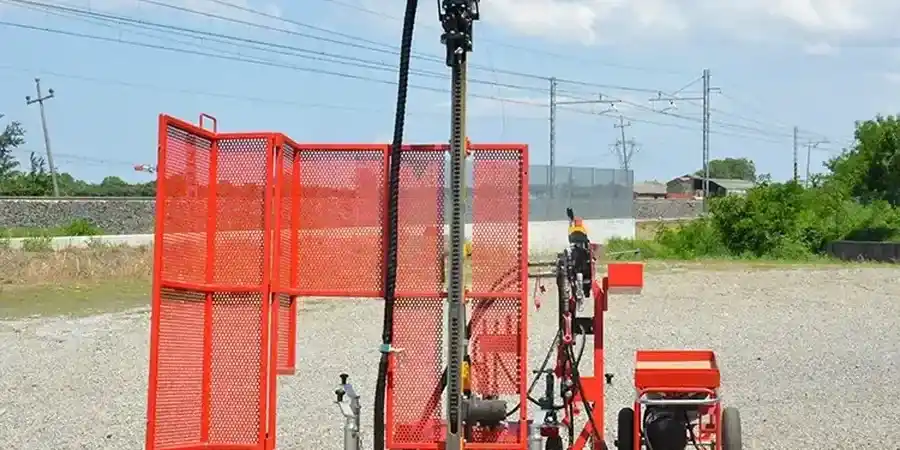
SPT N-values from Manchester's glacial till often exceed 50 blows per 300 mm, while alluvial zones can yield values as low as 4 to 8 blows per 300 mm.
Scope of work in Manchester
Critical ground factors in Manchester
Manchester's weather is no secret. With annual rainfall exceeding 800 mm and a shallow water table in many low-lying areas, the ground can change significantly between seasons. We have seen sites where the water table rises by over a metre between a winter and summer investigation. This fluctuation directly affects SPT blow counts in fine-grained soils, where partial saturation can give artificially high N-values. We always record groundwater levels and correlate with long-term piezometric data. In areas like the Irwell Valley, the presence of soft compressible clays requires correction of N-values for overburden pressure before using them in bearing capacity or liquefaction assessments. Ignoring these corrections can lead to settlements far beyond what the foundation was designed for.
This service complements our laboratory testing work for a complete project analysis.
Our services
Our SPT service in Manchester covers the full investigation cycle, from borehole drilling to final report. We offer three core options depending on project phase and budget.
Standard SPT Boreholes
Cable percussion drilling with SPT at 1.5 m intervals or at strata changes. Includes sample recovery, field logging and N-value reporting to BS 5930.
SPT for Pile Design
Continuous or semi-continuous SPT profiling in the pile founding zone. We correlate N-values to shaft friction and end-bearing using Meyerhof and Eurocode 7 methods.
SPT with Liquefaction Assessment
For sites in seismic zones or near the Manchester Ship Canal, we combine SPT with fines content analysis and apply the NCEER (Youd-Idriss) method to evaluate cyclic resistance.
Quick answers
How much does an SPT test cost in Manchester?
For a standard SPT borehole in Manchester, the cost typically ranges between £400 and £570 per test point, including drilling, sampling and field reporting. The final price depends on the depth required, number of tests and site access conditions.
What is the difference between N-value and corrected N60?
The raw blow count recorded in the field is the N-value. N60 applies a correction for hammer energy efficiency, typically around 60% for a standard trip hammer. For design to Eurocode 7, we always report both raw and corrected N60 values, as the latter is used in bearing capacity and settlement calculations.
How deep can you perform SPT testing in Manchester?
We routinely drill SPT boreholes to 20 metres depth using cable percussion rigs. In areas with shallow bedrock, such as the Manchester sandstone ridge, refusal is often encountered above 10 metres. For deeper investigations we can mobilise rotary rigs with SPT capability down to 50 metres.
Do you need planning permission for SPT boreholes in Manchester?
Most SPT boreholes for site investigation are permitted development under the Town and Country Planning Act, provided they are completed within 28 days and the site is restored. We handle all notifications to the local authority and utility searches to avoid underground activities.
Can SPT be used to assess liquefaction risk in Manchester?
Yes. Although Manchester is not in a high seismicity zone, the UK National Annex to Eurocode 8 requires liquefaction checks for certain structures. We use the NCEER 1997 method, which relies on corrected N-values and fines content, to evaluate cyclic resistance. This is particularly relevant for sites along the Mersey and Irwell valleys where loose saturated sands exist.